AIBE preparation strategy
The All India Bar Examination (AIBE) is a qualifying test, not a ranking exam. You are not competing for a position. You need to reach the pass mark, which has been reported as 45% for General and OBC candidates and 40% for SC, ST and PwD candidates. That makes preparation a planning problem. This guide gives you a plan that works whichever exam cycle you are aiming for.
The short answer
Study the subjects worth 8–10 marks first (Constitutional Law, CrPC/BNSS, CPC, IPC/BNS, Evidence/BSA, Family Law and the Contract group). Then cover the smaller subjects. Spend the last two weeks on revision and full-length mocks. Practise with bare acts, because they are allowed in the hall. Attempt every question, since there is no negative marking.
What the exam looks like
| Feature | What has been reported or published |
|---|---|
| Conducted by | Bar Council of India |
| Purpose | Qualifying exam leading to the Certificate of Practice |
| Questions | 100 multiple-choice questions, 1 mark each |
| Subjects | 19 |
| Negative marking | None |
| Mode | Offline, pen and paper, OMR sheet |
| Duration | Reported as 3 hours 30 minutes |
| Qualifying marks | 45% General/OBC, 40% SC/ST/PwD |
| Language | Question papers are offered in several languages |
Check each cycle (update this box every time)
These items change, so always confirm them on the official portal, allindiabarexamination.com:
- Exam date, registration window and fee deadline
- Admit card date and exact exam timings
- Eligibility rules (especially for final-year students and undertaking-based candidates)
- Whether the syllabus or question distribution has changed
- The examination guidelines issued with the admit card
- Whether the passing percentage has changed
Official AIBE Portal:
https://www.allindiabarexamination.com/
Is AIBE open book?
You will find both answers online. The official examination guidelines for a recent edition allowed candidates to carry bare acts without notes and comments, and barred phones, bags, calculators, papers, books and notes.
The accurate answer is: not open book in the old sense, but bare acts are permitted. So you are not learning every section number by heart. You are learning which Act answers which kind of question, and how to find the provision fast. Read the guidelines issued with your own admit card, as rules can be tightened.
Where the marks are
| Subject | Questions |
|---|---|
| Constitutional Law | 10 |
| Criminal Procedure Code / BNSS | 10 |
| Code of Civil Procedure | 10 |
| Indian Penal Code / BNS | 8 |
| Evidence Act / BSA | 8 |
| Family Law | 8 |
| Contract, Specific Relief, Property Laws, Negotiable Instruments Act | 8 |
| Law of Torts (incl. Motor Vehicles Act, Consumer Protection) | 5 |
| ADR including Arbitration | 4 |
| Public Interest Litigation | 4 |
| Professional Ethics and BCI Rules | 4 |
| Labour and Industrial Law | 4 |
| Taxation Law | 4 |
| Administrative Law | 3 |
| Company Law | 2 |
| Environmental Law | 2 |
| Cyber Law | 2 |
| Land Acquisition Act | 2 |
| Intellectual Property Laws | 2 |
| Total | 100 |
How to read this like a strategist
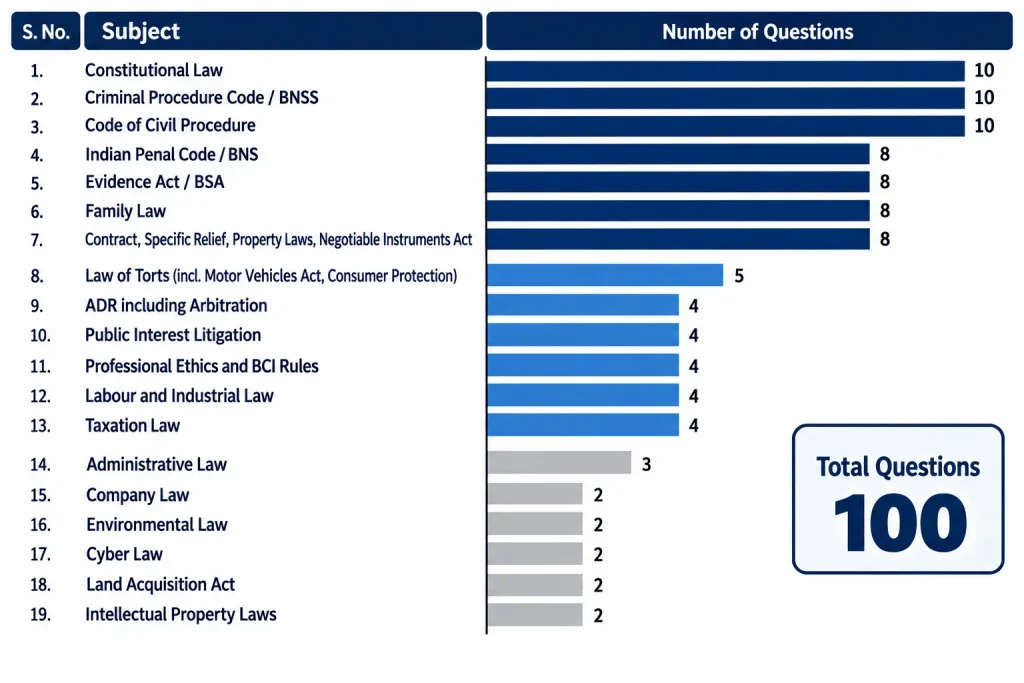
The top seven rows add up to 62 marks, nearly two-thirds of the paper. As an illustration (not a prediction): 70% in those seven areas is about 43 marks, and half of the remaining 38 adds about 19, which clears the pass line comfortably.
Do not take that as permission to skip the rest. The small subjects, such as Professional Ethics, Cyber Law, Company Law, Land Acquisition and IPR, are short and fact-based. A day or two on each wins cheap marks. Spend the most time on big subjects, but give no subject zero.
The core method: convert marks into days
A simple rule: give each subject about half a day of study per mark, and never less than one day for any subject. Then reserve roughly a quarter of your total time for revision and mocks.
Here is how that looks for a full 56-day plan (about 43 learning days and 13 revision/mock days):
| Order | Subject | Days |
|---|---|---|
| 1 | Constitutional Law | 5 |
| 2 | Professional Ethics | 2 |
| 3 | CrPC / BNSS | 4 |
| 4 | IPC / BNS | 3 |
| 5 | CPC | 4 |
| 6 | Evidence / BSA | 3 |
| 7 | Contract group | 4 |
| 8 | Family Law | 3 |
| 9 | Torts, ADR, PIL, Labour | 2 + 2 + 1 + 2 |
| 10 | Taxation | 2 |
| 11 | Administrative, Company, Environmental, Cyber, IPR, Land Acquisition | 1 each |
| 12 | Revision of the big seven | 6 |
| 13 | Full mocks and weak-area repair | 7 |
This allocation is a recommendation, not an official schedule.
Scaling the plan to your timeline
| Your timeline | What to change |
|---|---|
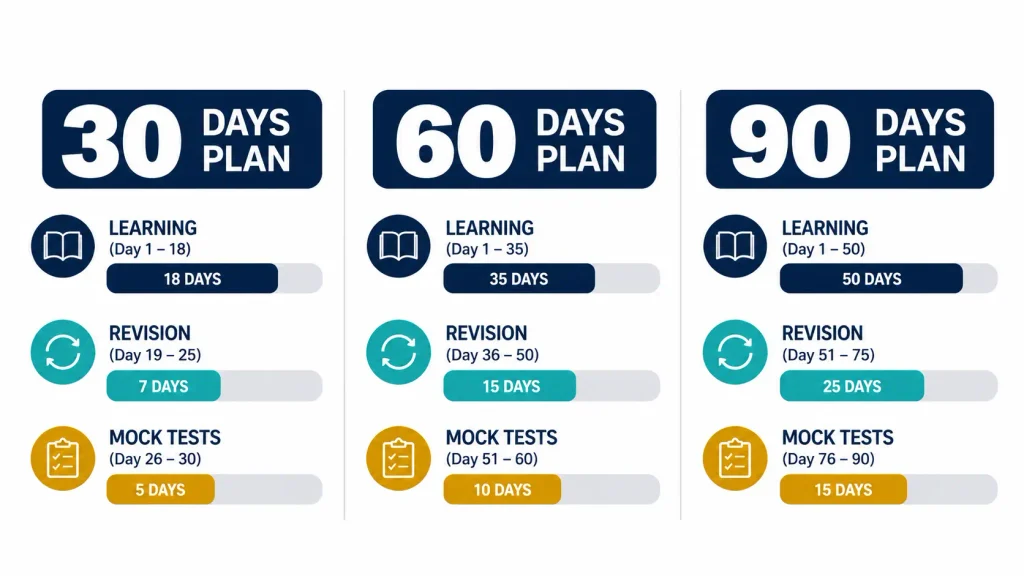
| 30 days | Only for strong revisers. Cover the big seven in about 18 days, small subjects in about 6 days, keep 6 days for mocks. Expect shallow coverage in the small subjects. |
| 60 days | Use the table above as written. |
| 90 days | Multiply learning days by about 1.5, add a second revision cycle, and take mocks weekly from week 6. |
| Part-time (1–2 hours a day) | Double the plan. One subject per week with a daily question set beats trying to copy a full-time schedule. |
Who this works for, and who must adjust
No plan fits everyone. Be honest about where you stand.
- You have finished LLB and are revising familiar subjects. The 60-day plan is built for you.
- You are a final-year student with a heavy college schedule. Stretch to 90 days or more. Compressing creates shallow learning in the big subjects.
- You are starting nearly from zero, especially in CPC, Evidence or Constitutional Law. Plan 90+ days, or target the next cycle instead of cramming.
- You are a working professional. Use the part-time version and protect a fixed daily slot.
Be careful with claims that “X days is enough for everyone.” It depends on your starting point.
How to study each subject
Use the same loop everywhere so you do not waste time deciding how to study:
- Skim the bare act’s index to learn its structure.
- Read the key provisions once, slowly. Do not try to master everything.
- Solve 20–30 previous-year MCQs on that subject the same day. The questions show you what is actually asked.
- Keep a one-page “traps” list of provisions you got wrong, easily confused terms and time limits.
Subject notes:
- Constitutional Law: fundamental rights, writs, and the structure of Parliament, the executive and the judiciary.
- Family Law: keep each personal law and statute in separate notes so they do not blur.
- Torts: questions tend to test principles, so understand the idea more than section numbers.
- Professional Ethics: short and rule-based, so it rewards a careful read of the BCI rules.
Handling the new criminal laws (BNS, BNSS, BSA)
The syllabus lists the Bharatiya Nyaya Sanhita beside the IPC, the Bharatiya Nagarik Suraksha Sanhita beside the CrPC, and the Bharatiya Sakshya Adhiniyam beside the Evidence Act. Together these carry 26 marks.
- Use the new codes as your main text, as that is where the law now sits.
- Keep a short old-to-new mapping for sections you already know, so you can answer whichever name the question uses.
- Check the official syllabus PDF for exactly how old and new laws are listed in your cycle.
- Verify any mapping against the bare act itself, not a random website.
Using bare acts in the exam hall
Bare acts help when used with discipline. A workable rule: answer from knowledge first. Open the bare act only when you can narrow the answer to two options, or when the question turns on exact wording or a time limit. Looking up every question will eat your time.
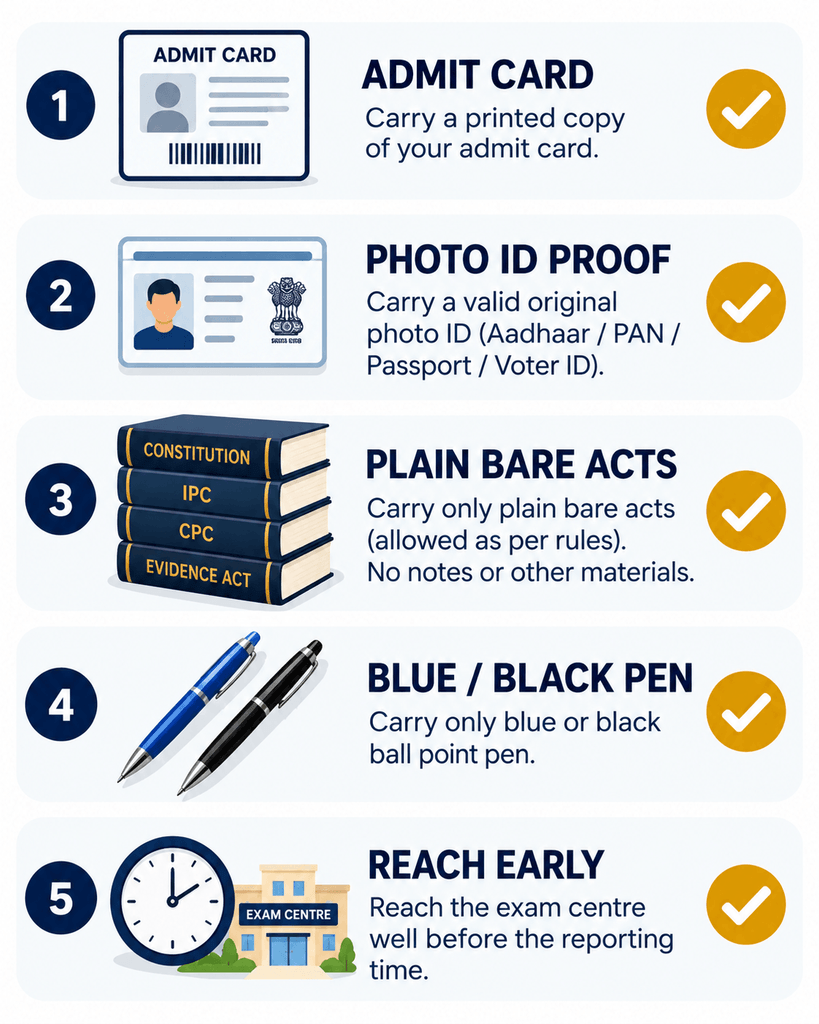
Carry only plain bare acts with no notes or commentary. Because the rule says “without notes and comments,” keep your copies clean, and read your admit card instructions on markings and tabs before the day.
Mock-test strategy
- Practise on paper, with an OMR-style sheet if possible, because the exam is offline.
- Time yourself. 100 questions in about 3.5 hours is roughly two minutes each. Aim to finish a first pass in about two hours, leaving time for bare-act checks.
- Never leave a question blank. There is no negative marking, so eliminate options and choose.
- Sort every wrong answer into three types: did not know, knew but misread, knew but ran out of time. Each needs a different fix.
- Start with official past papers, then other material.
Common mistakes
- Studying by popularity instead of marks.
- Reading without practising questions.
- Skipping small subjects.
- Building notes you cannot carry into the hall.
- Trusting outdated pages that describe older rules.
- Using bare acts that do not reflect current law.
- Missing the registration deadline, which always comes before the exam.
The final week
- Download your admit card as soon as it is live and check every detail.
- Reach the exam city early if travel is long, and carry the admit card with a government photo ID.
- Learn no new topics. Review your traps lists and re-solve wrong mock questions.
- Pack plain bare acts and a blue or black ball pen. Earlier guidelines say pencil marking can lead to disqualification.
- Sleep. A tired mind misreads simple questions.
FAQs
As reported, 45 out of 100 for General and OBC candidates and 40 for SC, ST and PwD candidates. If questions are withdrawn, the cut-off has been recalculated on the reduced paper before, so check after the answer key.
Constitutional Law, CrPC/BNSS and CPC carry 10 questions each. IPC/BNS, Evidence/BSA, Family Law and the Contract group carry 8 each.
Not as reported. Attempt every question.
Only bare acts without notes and comments, per the official guidelines for a recent edition. Confirm with your own admit card.
It depends on your starting point. Around 60 days suits someone revising subjects they already know. Beginners and working professionals should plan 90 days or more.
It draws on core LLB subjects, but it is tested through MCQs on bare-act provisions, so the style of preparation differs from a university exam.
The syllabus lists both. Use the new codes as your main text and keep a short mapping to the old law.
You become eligible for the Certificate of Practice, subject to enrolment with a State Bar Council. Candidates who qualified through an undertaking route have separate enrolment-certificate deadlines, so read the current BCI notice.
For the latest AIBE 22 dates, verified syllabus, eligibility, registration details and a current study plan, see our [Corrected AIBE 22 Guide: Verified Syllabus, Dates & Study Plan (Not Recycled AIBE 21 Info)].
Conclusion
AIBE rewards a plan more than raw effort. Know the pass mark, study where the marks are, practise questions daily, and treat your final two weeks as mock-test weeks. If your timeline is short, adjust the plan honestly instead of cramming. Whatever your starting point, begin with Constitutional Law.
General guidance for exam preparation, not legal or professional advice. Always confirm dates, eligibility and rules on the official BCI AIBE portal.

ZAKIR HUSSAIN SAHIK
Legal education content creator helping law students find useful study resources and exam information.