Last verified: 29 September 2026. Source: High Court of Andhra Pradesh Notification No. 118/2026-RC dated 25.09.2026.
The High Court of Andhra Pradesh has invited online applications for 119 Civil Judge (Junior Division) posts. Applications open on 1 October 2026 and close on 26 October 2026 at 11:59 PM, only through the High Court website, aphc.gov.in.
This guide is built directly from the official notification. Where the notification is unclear, we say so instead of guessing.
Quick answer
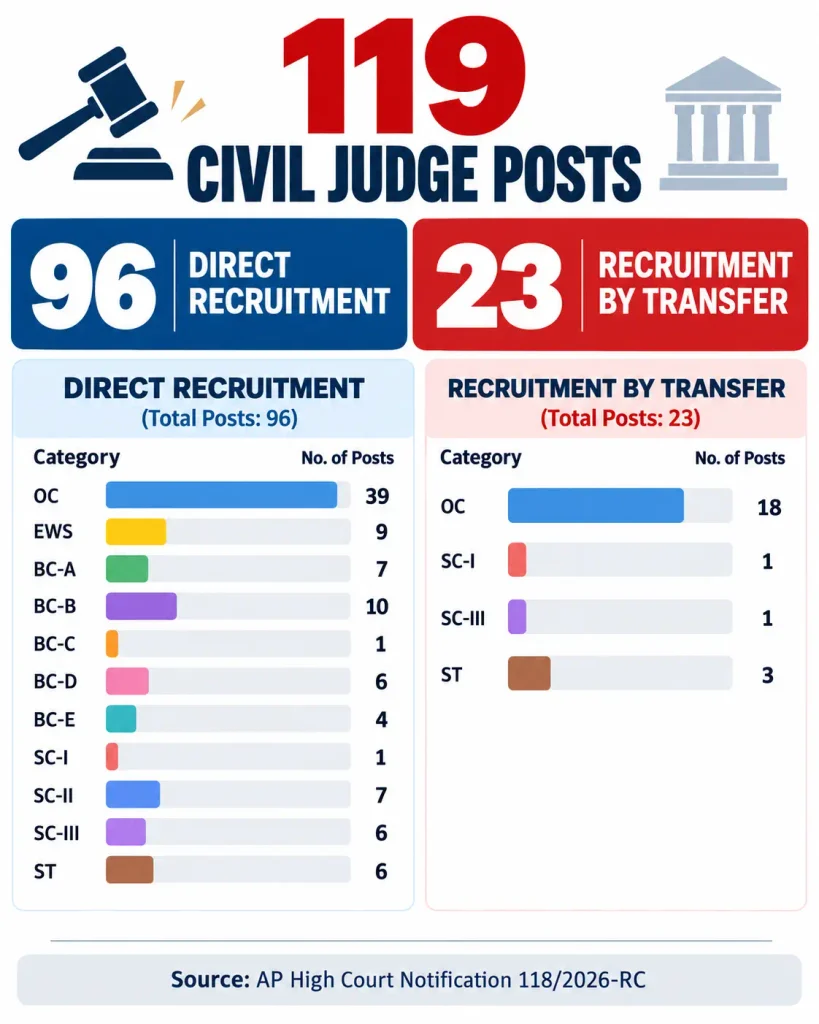
- Posts: 119 (96 Direct Recruitment + 23 Recruitment by Transfer)
- Pay scale: Rs. 77,840 – 1,36,520
- Apply: 1 Oct to 26 Oct 2026 (till 11:59 PM), online only
- Selection: Screening test (CBT) → Written exam → Viva voce
- Fee: Rs. 1,500 (OC/EWS/BC); Rs. 750 (SC/ST/Persons with Benchmark Disabilities, with a condition explained below)
- Age (Direct Recruitment): below 35 as on 1 Sept 2026, with relaxations
- Screening test date: not announced yet
TABLE OF CONTENTS
AP Civil Judge Notification 2026 at a glance
| Item | Details |
|---|---|
| Recruiting body | High Court of Andhra Pradesh, Amaravati |
| Notification | No. 118/2026-RC, dated 25.09.2026 |
| Post | Civil Judge (Junior Division), A.P. State Judicial Service |
| Total vacancies | 119 |
| Governing rules | A.P. State Judicial (Service & Cadre) Rules, 2026 |
| Application mode | Online only, at aphc.gov.in |
| Screening test | Computer-based, 100 MCQs, 100 marks, 2 hours |
| Written exam | 3 papers, 100 marks each, 3 hours each |
| Viva voce | 50 marks |
| Screening test centres | Guntur, Kurnool, Rajahmundry, Tirupati, Vijayawada, Visakhapatnam |
Important dates
| Event | Date |
|---|---|
| Online applications open | 1 October 2026 |
| Last date to apply | 26 October 2026, 11:59 PM ( extended to 10.11.2026 by 11.59 P.М) |
| Hall tickets | Downloadable one week before the screening test |
| Screening test (CBT) | To be notified |
| Question paper and preliminary key | Within one week after the screening test, with a window for objections |
The High Court says these dates are final unless it modifies them, and any change will appear on its website. There is also a clear instruction: keep checking the website, because no separate information will be sent by any other mode.
Vacancies
Direct Recruitment: 96 posts
| Category | Posts | Of which for women |
|---|---|---|
| Open Competition | 39 | 13 |
| EWS | 9 | 3 |
| Backward Class (Group-A) | 7 | 2 |
| Backward Class (Group-B) | 10 | 3 |
| Backward Class (Group-C) | 1 | none stated |
| Backward Class (Group-D) | 6 | 2 |
| Backward Class (Group-E) | 4 | 1 |
| SC Group-I | 1 | none stated |
| SC Group-II | 7 | 2 |
| SC Group-III | 6 | 2 |
| ST | 6 | 2 |
| Total | 96 |
Within the 39 Open Competition posts, the notification also sets aside one post each for four disability categories: blindness or low vision; deaf and hard of hearing; locomotor disability (including cerebral palsy, cured leprosy, dwarfism, acid attack victims and muscular dystrophy); and autism, intellectual disability, mental illness and multiple disabilities.
Recruitment by Transfer: 23 posts
| Category | Posts |
|---|---|
| Open Competition | 18 |
| SC Group-I | 1 |
| SC Group-III | 1 |
| ST | 3 |
| Total | 23 |
Two notes on vacancies
- The High Court can increase or decrease vacancies, or cancel the notification at any stage without giving reasons. Applying gives no right to the post.
- Selection against the BC-E vacancies is subject to the outcome of Civil Appeal Nos. 2628–2637/2010 pending before the Supreme Court.
Do not mix this up: A separate High Court notification (No. 366/2026-RC, dated 17 September 2026) is for Civil Judge (Senior Division) through a limited departmental exam, open only to serving Junior Division judges. It is not this recruitment.
Who can apply? Eligibility
Direct Recruitment
The candidate must be a law graduate, of good character, and free from any infirmity that makes them unfit for the post. “Direct Recruitment” means a person who is not already in the service of the Government of India or a State.
The Bhumika Trust ruling, in plain English
The notification links the qualification rule to the Supreme Court judgment in Bhumika Trust v. Union of India (Writ Petition (Civil) No. 1110/2025, decided 21.08.2026) and to pending amendments of the A.P. Judicial Service Rules. For a detailed explanation of how this ruling affects Civil Judge eligibility, see our guide on JCJ Eligibility After Supreme Court’s 21 Aug 2026 Ruling: New Rules.
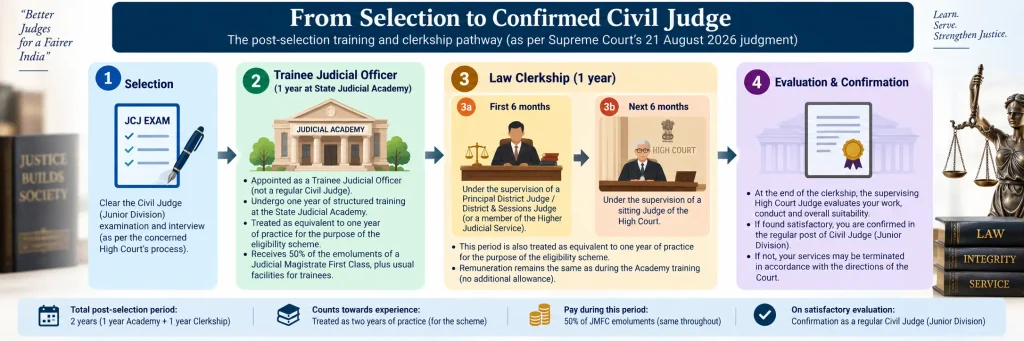
Here is the background. In May 2025, the Supreme Court had restored a rule that candidates need three years of practice at the Bar before appearing for Civil Judge exams. On 21 August 2026, a three-judge bench (2026 INSC 904, by a 2:1 majority) modified that. As summarised by legal education sites, the Court set up a transition: advertisements issued up to 31 March 2027 are open to law graduates despite the three-year rule, and for advertisements issued on or after 1 April 2027, candidates need at least one year of actual practice. The judgment also introduces one year of judicial academy training plus one year of law clerkship for selected candidates, which the notification reflects (see “Training” below).
Note that the practice-rule details above come from summaries of the judgment, not from the AP notification itself. Read the judgment or an official summary if you need the exact wording.
The one line to verify before you pay
The notification says all law graduates “who have obtained Law Degree preceding one year as on the date of Notification” are eligible. This sentence can be read in more than one way, and different websites paraphrase it differently (one says “within one year”).
What we can say for certain: the notification itself attaches this line to the Bhumika Trust judgment and to pending rule amendments. So the safest path is to:
- read Section II(A) of the official PDF on aphc.gov.in yourself,
- check the online application form’s eligibility declaration, and
- if your case is borderline (for example, your degree date), confirm before paying the non-refundable fee.
Who is not eligible (Direct Recruitment)
A person is ineligible if they:
- are not a citizen of India;
- were dismissed, removed or compulsorily retired from judicial or government/statutory/local authority service;
- were convicted of an offence involving moral turpitude;
- were permanently debarred by the High Court, UPSC or a State Public Service Commission;
- tried to influence the recruitment authority directly or indirectly;
- have more than one wife living, or (for women) married a man who already has a wife;
- were arrested in connection with a crime involving moral turpitude and concerned with it.
Also excluded: candidates who committed copying or misconduct in an earlier exam, failed to complete probation in any judicial or other service, or were found of doubtful integrity in any year.
Recruitment by Transfer
You need a law degree from a university established by law in India, and you must be a confirmed member or approved probationer in one of these groups:
- High Court of A.P. staff such as Section Officers, Court Officers, Scrutiny Officers, Court Masters, Personal Secretaries to Judges and Registrars, Translators, Computer Operators, U.D. Stenographers, Assistants, Examiners, Typists and Copyists;
- District Judiciary staff in A.P. (Chief Administrative Officers, Senior Superintendents, Superintendents, Stenographers, Senior/Junior Assistants, Typists);
- Assistant Public Prosecutors, Senior APPs and Additional Public Prosecutors Grade-II;
- Section Officers in the Law Department or the Legislature Department of the A.P. Secretariat;
- Managers of the Advocate General’s offices, Government Pleaders and Public Prosecutors, and the Editor, I.L.R.
You must have good character, no pending disciplinary charges, no punishment (past or subsisting) for irregularity in duty, and you must submit a No-Objection Certificate from your employer at document verification.
Age limit and relaxations
| Route | Upper age limit | Reckoning date |
|---|---|---|
| Direct Recruitment | Must not complete 35 years | 1 September 2026 |
| Recruitment by Transfer | Must not complete 48 years | 1 September 2026 |
Relaxations (Direct Recruitment):
- 5 years for SC, ST, Backward Classes and EWS
- 10 years for Persons with Benchmark Disabilities
- Defence service rendered is excluded when computing age
Practical example: A BC candidate can be up to 5 years older than the general limit, so someone who has not completed 40 on 1 September 2026 stays within the relaxed limit. Confirm how your specific combination of relaxations is treated in the official form.
Application fee
| Category | Fee |
|---|---|
| Open Category / EWS / BC | Rs. 1,500 |
| SC / ST / Persons with Benchmark Disabilities | Rs. 750 |
Two points people miss:
- The Rs. 750 concession is stated to be for applicants from a community recognised as SC/ST in the State of Andhra Pradesh.
- The fee is paid online and is not refunded, even if the application is rejected or the notification is cancelled.
Selection process, stage by stage
Stage 1: Screening test (computer-based)
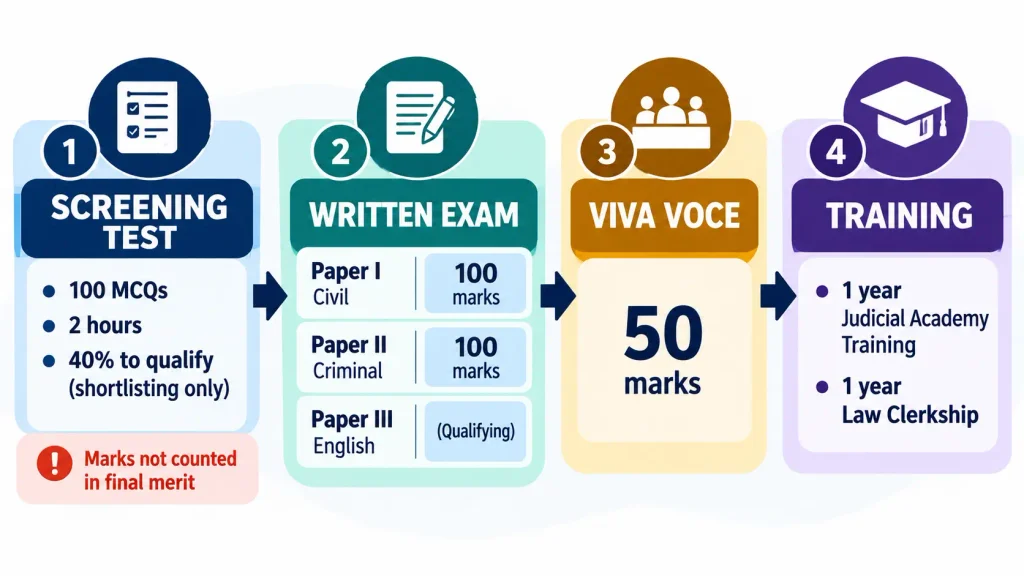
- 100 objective (MCQ) questions, 100 marks, 2 hours.
- Candidates scoring 40% or more are shortlisted for the written exam in the ratio 1:10 of available vacancies. Scoring the minimum does not guarantee a call.
- If several candidates have identical marks at the cut-off, all of them are called.
- These marks are not added to your written exam marks and are not used for the final merit order. Its only job is shortlisting.
What the 1:10 ratio means: roughly ten candidates per vacancy are shortlisted. The notification does not spell out whether this is applied overall or category-wise, so do not treat any specific “expected cut-off” figure on other sites as official.
Stage 2: Written examination (3 papers)
| Paper | Subject | Marks | Time |
|---|---|---|---|
| I | Civil Laws | 100 | 3 hours |
| II | Criminal Laws | 100 | 3 hours |
| III | English (Translation and Essay Writing) | 100 | 3 hours |
Answers must be in English (except the translation test).
Paper III has two parts:
- Part I (40 marks): translate a passage from English to Telugu and from Telugu to English.
- Part II (60 marks): essay on legal subjects only.
You must secure 40% in each part of Paper III. But Paper III marks are not considered for viva eligibility or for selection. Only Paper I, Paper II and the viva count toward selection. Treat Paper III as a compulsory hurdle, not a scoring paper.
The notification does not state the number of questions per paper, so ignore claims of a fixed question count unless you find them in the official document.
Stage 3: Viva voce
- 50 marks.
- Candidates who qualify the written exam are called in the ratio 1:3 of available vacancies in the respective categories (ties at the cut-off are all called).
- Absent means disqualified.
Minimum marks to reach the viva
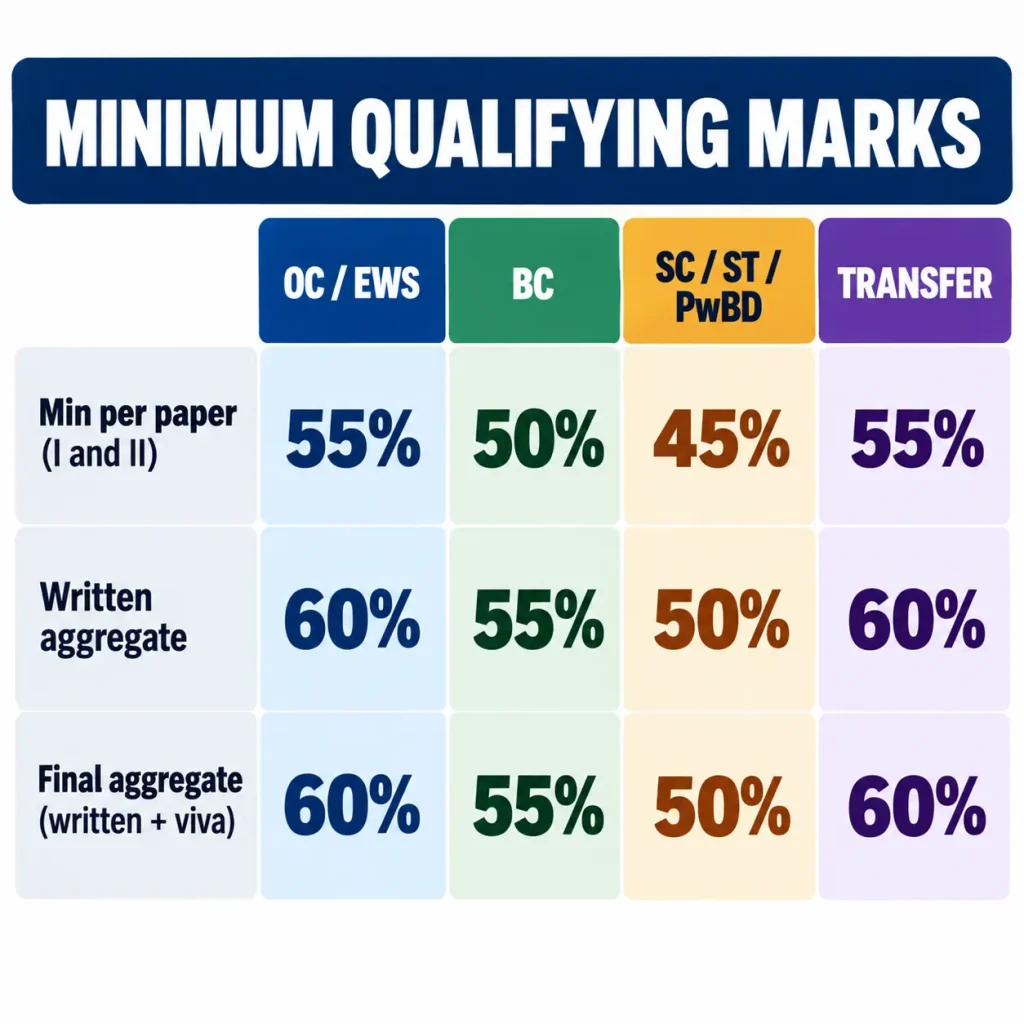
| Category (Direct Recruitment) | Each of Paper I and Paper II | Aggregate in written exam |
|---|---|---|
| Open Competition / EWS | 55% | 60% |
| Backward Class | 50% | 55% |
| SC / ST / Persons with Benchmark Disabilities | 45% | 50% |
| Recruitment by Transfer | 55% | 60% |
Minimum marks for final selection (written exam + viva)
| Category | Minimum aggregate |
|---|---|
| OC / EWS (Direct Recruitment) | 60% |
| BC (Direct Recruitment) | 55% |
| SC / ST / Persons with Benchmark Disabilities (Direct Recruitment) | 50% |
| Recruitment by Transfer | 60% |
What score do you need? A worked example
This section is our calculation from the notification’s percentages, not an official statement.
Since Paper I (100) + Paper II (100) + Viva (50) = 250 marks count toward selection, an Open Competition candidate needing 60% in aggregate would need about 150 out of 250. But that is only the floor. The 55% minimum in each paper means at least 55/100 in Paper I and 55/100 in Paper II even before the viva. Since there are only 96 direct recruitment posts, the real cut-off will depend on competition.
The point: a very high score in one paper cannot rescue a low score in the other.
Tie-breaking
If marks are equal after written exam and viva, the elder candidate is preferred; then the one with the higher educational qualification; then the one with the highest marks in the prescribed qualification.
Syllabus for the screening test and written exam
The same syllabus applies to both. The notification lists the following.
Civil Laws (13 items)
- Code of Civil Procedure, 1908
- Indian Contract Act, 1872
- Hindu Marriage Act, 1955
- Hindu Succession Act, 1956
- Indian Easements Act, 1882
- Specific Relief Act, 1963
- Limitation Act, 1963
- Transfer of Property Act, 1882
- Civil Rules of Practice
- Registration Act, 1908 and Indian Stamp Act, 1899
- A.P. Land Encroachment Act, 1905
- Indian Evidence Act, 1872
- Bharatiya Sakshya Adhiniyam, 2023 (BSA)
Criminal Laws (16 items)
- Code of Criminal Procedure, 1973
- Indian Evidence Act, 1872
- Indian Penal Code, 1860
- Bharatiya Nagarik Suraksha Sanhita, 2023 (BNSS)
- Bharatiya Sakshya Adhiniyam, 2023 (BSA)
- Bharatiya Nyaya Sanhita, 2023 (BNS)
- Negotiable Instruments Act, 1881
- Protection of Women from Domestic Violence Act, 2005
- Criminal Rules of Practice
- A.P. Excise Act, 1968
- A.P. Gaming Act, 1974
- Juvenile Justice (Care and Protection of Children) Act, 2015
- Food Safety and Standards Act, 2006
- Information Technology Act, 2000
- Protection of Children from Sexual Offences (POCSO) Act, 2012
- A.P. Forest Act, 1967
Why this matters: Both the old laws and the new criminal laws are listed, so you should be comfortable with each pair (IPC/BNS, CrPC/BNSS, Evidence Act/BSA). Also, four criminal-law items (Food Safety Act, IT Act, POCSO, A.P. Forest Act) are missing from several syllabus lists online. The Constitution of India is not a listed subject in this notification.
Glossary: BNS replaces the IPC (offences); BNSS replaces the CrPC (procedure); BSA replaces the Indian Evidence Act (proof).
Documents to upload
Direct Recruitment
- Date of birth / SSC certificate
- Law degree certificate
- Community certificate (if claiming SC, ST, BC, EWS or disability reservation; for BC it must show the group classification)
- Latest Non-Creamy Layer certificate (issued in 2025 or 2026) for BC candidates. Without it, you are considered under Open Competition only.
- Latest EWS certificate (2025 or 2026) from the Tahsildar showing gross annual family income from all sources below Rs. 8,00,000
- Medical Board certificate stating the nature and percentage of disability (for Persons with Benchmark Disabilities)
- Discharge certificate (Ex-Servicemen)
Recruitment by Transfer
- Date of birth / SSC certificate, law degree, community certificate (SC/ST)
- Proof of declaration of probation
- Employer’s proceedings permitting you to study law after joining service
- Latest Service and Conduct Certificate
- No-Objection Certificate from the employer (at original verification)
Once you submit, you cannot edit options or replace documents. Original certificates must be produced on the date the High Court specifies. Missing any required certificate leads to rejection.
Training after selection
Selected candidates are first designated Trainee Judicial Officers:
- One year of compulsory training at the Judicial Academy, on a fixed emolument equal to half of a Civil Judge (Junior Division)’s remuneration.
- Then one year of Law Clerkship: the first six months under Principal District/Sessions Judges or Higher Judicial Service members, the next six months under a High Court Judge, on the same emoluments as the academy period.
- A reasoned evaluation report from the High Court Judge. If satisfactory, the trainee is appointed to the regular post and gets the regular pay scale.
How to apply, step by step
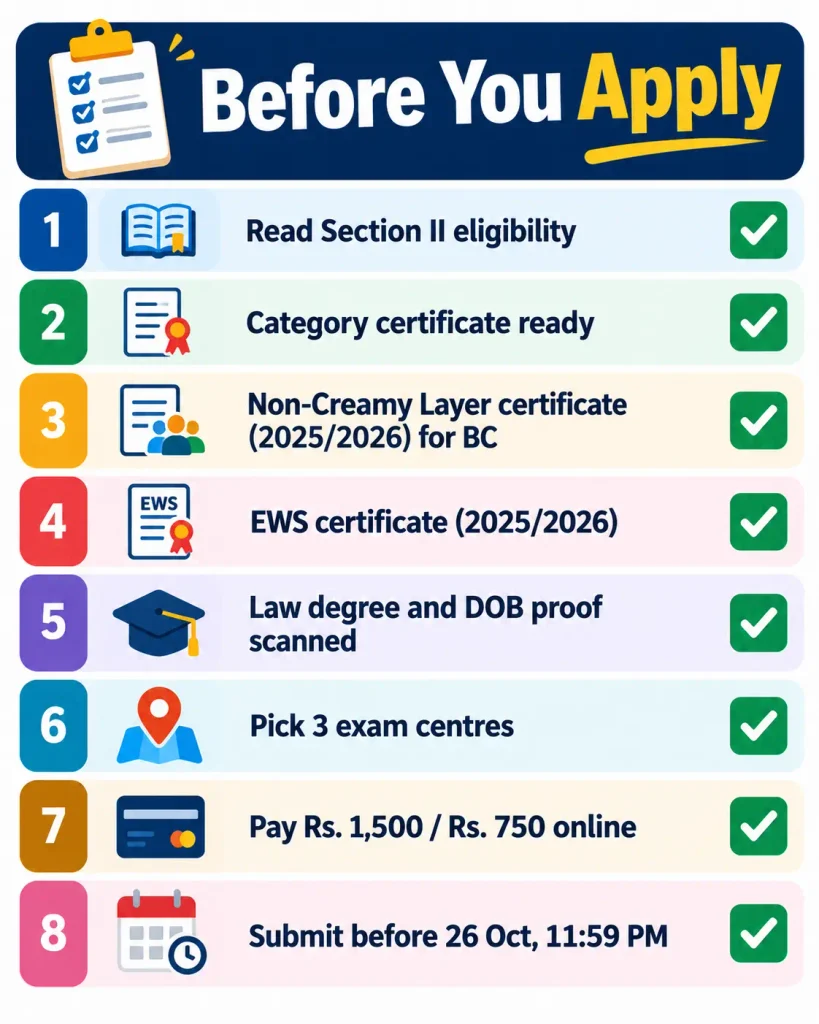
- Open aphc.gov.in from 1 October 2026 and find Notification No. 118/2026-RC.
- Read the eligibility section and the declarations carefully.
- Choose your route (Direct Recruitment or Recruitment by Transfer) and your category.
- Choose three screening test centres in order of preference. The High Court may allot a different centre, and change requests are not entertained.
- Upload the required documents (keep scans clear and current).
- Pay the fee online.
- Submit before 11:59 PM on 26 October 2026, and save the confirmation.
Do not wait for the last day. Servers get heavy near deadlines, and you cannot fix errors afterwards.
How to plan your preparation
The notification gives no subject-wise weightage, so nobody can honestly tell you “CPC carries X marks.” What it does give us is structure: two full-weight subject papers (Civil and Criminal, equal marks), an essay-and-translation paper you must simply pass, and a syllabus with 13 civil and 16 criminal items. Here is a planning approach built from that structure. It is our recommendation, not official guidance.
| Focus area | Suggested share of study time | Reason |
|---|---|---|
| Civil Paper: CPC, Contract, Transfer of Property, Specific Relief, Limitation, Evidence/BSA | Largest civil share | Core, large Acts that also feed the MCQ screening test |
| Civil Paper: Hindu Marriage/Succession, Easements, Registration/Stamp, A.P. Land Encroachment, Rules of Practice | Moderate | Shorter Acts, easy to under-prepare |
| Criminal Paper: BNS/IPC, BNSS/CrPC, BSA/Evidence | Largest criminal share | Foundation of the paper; study old and new law together |
| Criminal Paper: NI Act, DV Act, JJ Act, POCSO, IT Act, Food Safety, Excise, Gaming, Forest | Moderate | Many small Acts, each one a possible question source |
| Paper III: translation (English/Telugu both ways) and legal essay | Steady weekly practice | 40% needed in each part; writing skill improves only by practice |
Who this fits, and who should adjust:
- Recent graduates who studied these Acts recently: revising with mock tests is realistic.
- Starting from scratch on the new criminal laws: give BNS/BNSS/BSA extra time before mock tests.
- Working advocates or court staff (including the transfer route): you have practical exposure but less daily study time, so plan for a longer runway and protect Paper III practice.
- Non-Telugu-medium background: start translation practice early; Telugu to English is a scoring hurdle, not a bonus.
Because the screening test date is not yet announced, build your plan in phases (Acts once → revision → mocks) and adjust when the date is published. Do not promise yourself a fixed number of days.
Common mistakes to avoid
- Applying without checking the eligibility line on the qualification rule.
- Missing the Non-Creamy Layer (BC) or EWS certificate year requirement (2025 or 2026).
- Assuming the screening marks help your final rank. They do not.
- Ignoring Paper III because it is not counted for selection. It is still a qualifying hurdle.
- Studying only the new laws or only the old ones.
- Treating the Senior Division notification (16 posts) as the same recruitment.
- Waiting for an email. The High Court says updates are on its website only.
People Also Ask
No. It is only for shortlisting and is not added to written exam marks.
Yes, a viva voce of 50 marks, after the written exam.
The High Court of Andhra Pradesh. The notification is issued by its Registrar (Recruitment).
Yes. BNS, BNSS and BSA are listed along with IPC, CrPC and the Evidence Act.
FAQs
119 in total: 96 by Direct Recruitment and 23 by Recruitment by Transfer.
26 October 2026, up to 11:59 PM. Applications open on 1 October 2026.
The pay scale is Rs. 77,840 – 1,36,520. During the first year of academy training, trainees receive one-half of the remuneration payable to a Civil Judge (Junior Division).
Direct Recruitment: below 35 as on 1 September 2026 (relaxations: 5 years for SC/ST/BC/EWS, 10 years for Persons with Benchmark Disabilities, plus defence service excluded). Recruitment by Transfer: below 48 as on the same date.
The notification says all law graduates meeting its qualification wording are eligible, subject to the Bhumika Trust judgment and pending rule amendments. Because the degree-date wording is ambiguous, verify the exact rule on aphc.gov.in before applying.
40%, which lets you be considered for shortlisting at 1:10 of vacancies. It does not guarantee selection to the written exam.
OC/EWS: 55% in each of Papers I and II and 60% aggregate. BC: 50% and 55%. SC/ST/Persons with Benchmark Disabilities: 45% and 50%. Recruitment by Transfer: 55% and 60%.
No, but you must secure 40% in each of its two parts.
Guntur, Kurnool, Rajahmundry, Tirupati, Vijayawada and Visakhapatnam. You choose three in order of preference.
No.
No. Options cannot be edited and documents cannot be replaced after submission.
Conclusion
The AP Civil Judge (Junior Division) notification is unusually detailed, and most of what matters is in a handful of places: the eligibility wording, the percentage cut-offs by category, the screening-test rule (shortlisting only), and the document list. Read the PDF yourself once, verify the eligibility line, gather your certificates now, and apply well before 26 October.
This article is general information based on the official notification and public sources, not legal or professional advice. Always confirm details on aphc.gov.in.

ZAKIR HUSSAIN SAHIK
Legal education content creator helping law students find useful study resources and exam information.