
Last verified: 16 September 2026, against the Supreme Court’s judgment in Bhumika Trust v. Union of India & Ors., W.P.(C) No. 1110/2025 etc., 2026 INSC 904, decided 21.08.2026.
If you’ve been preparing for the Civil Judge (Junior Division) JCJ exam, you’ve probably heard two conflicting things: that fresh graduates can apply, and that you need three years of Bar practice. Both were true at different points in the last two years. On 21 August 2026, the Supreme Court modified its own 20 May 2025 judgment on this question. Here is what the judgment actually says.
TABLE OF CONTENTS
The short answer
- If the recruitment notification is issued after 20 May 2025 and up to 31 March 2027, this is the transitional period: law graduates remain eligible to apply notwithstanding the three-year practice requirement, and are treated as having completed one year of practice for purposes of the scheme. No Certificate of Practice is needed for that deemed year.
- If the notification is issued on or after 1 April 2027, a candidate must have completed at least one year of actual, verified practice — not three — supported by a Certificate of Practice, before being eligible to appear for the exam.
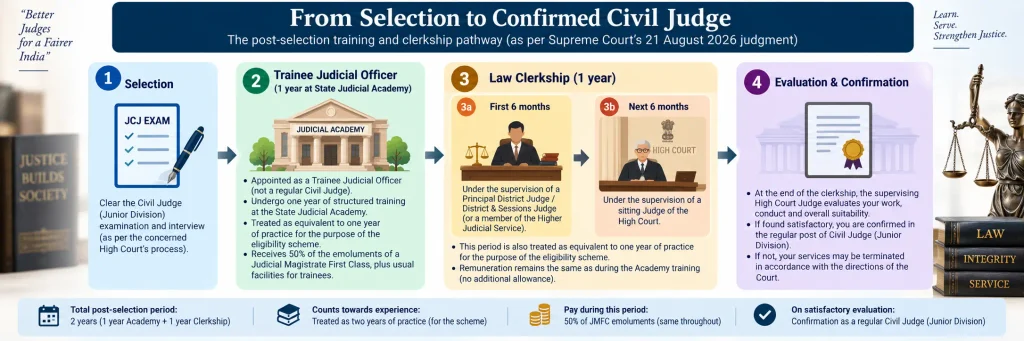
- In both cases, once selected, a candidate does not immediately take up a regular post. They undergo one year of training at the State Judicial Academy, followed by one year of Law Clerkship (six months under a District/Sessions Judge or a member of the Higher Judicial Service, then six months under a sitting High Court Judge), before being confirmed in the regular post.
- This framework is directed to remain in force for five years from the date of the judgment. After that period, its working will be placed before the Supreme Court, which may revisit it if necessary.
Everything below explains this in more detail.
How we got here a quick timeline of the practice requirement
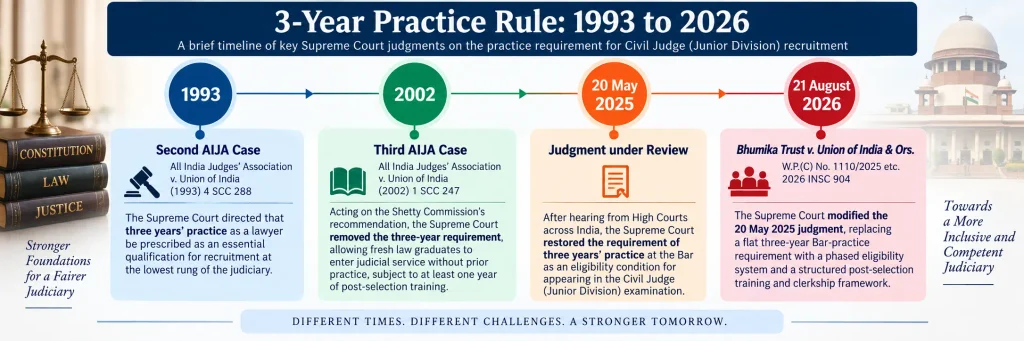
- 1993 (Second AIJA case): The Supreme Court directed that three years’ practice as a lawyer be prescribed as an essential qualification for recruitment at the lowest rung of the judiciary, reasoning that if the Constitution requires 7–10 years of practice for District and High Court judges, some experience should be expected at the entry level too.
- 2002 (Third AIJA case): Acting on the Shetty Commission’s recommendation, the Court removed the three-year requirement, allowing fresh law graduates to enter judicial service without prior practice, provided they received at least one year of post-selection training.
- 20 May 2025 (Judgment under Review): After hearing from High Courts across India, the Court restored the requirement of three years’ practice at the Bar as an eligibility condition for appearing in the Civil Judge (Junior Division) examination.
- 21 August 2026 (the ruling this article is about): The Supreme Court modified the 20 May 2025 judgment to the extent specified in its directions, replacing a flat three-year Bar-practice requirement with a phased, structured framework.
What the 21 August 2026 judgment actually changed
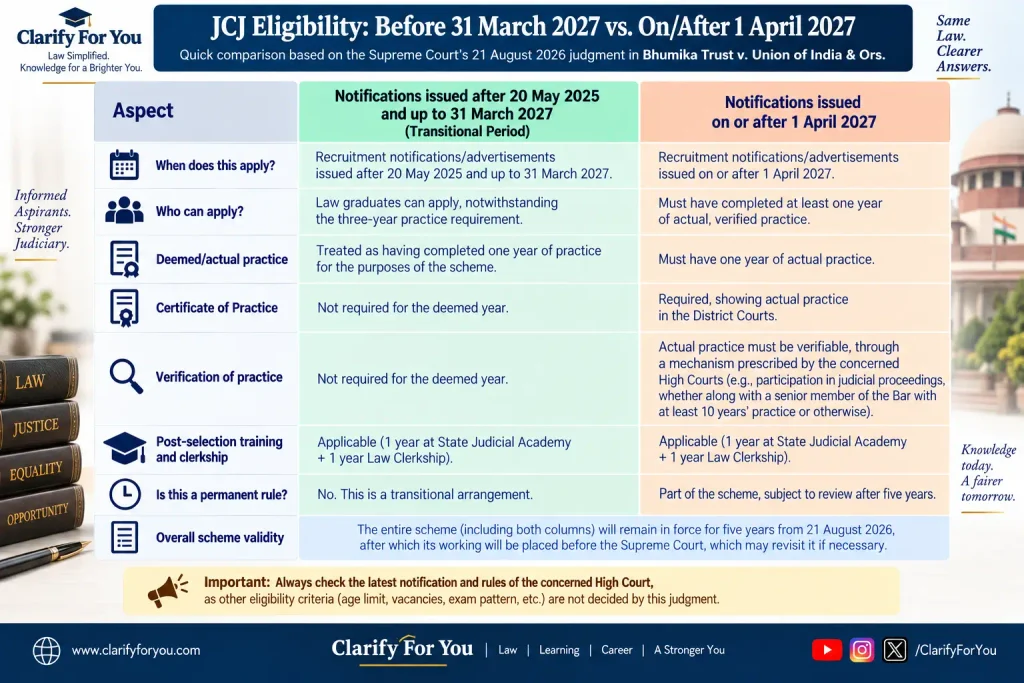
JCJ Eligibility After Supreme Court’s 21 Aug 2026 Ruling
The Court reaffirmed that familiarity with the functioning of courts is necessary before becoming a Civil Judge. It then considered a separate question: whether all of that competence must necessarily be acquired through conventional Bar practice before the examination, or whether it could also be secured through a combination of shorter actual practice and structured post-selection training. Its answer was a transitional arrangement plus a structured post-selection framework, described below.
The transitional arrangement (notifications issued after 20 May 2025, up to 31 March 2027)
For any Civil Judge (Junior Division) recruitment notification issued after the 20 May 2025 judgment and up to 31 March 2027, the Court has provided a transitional arrangement under which:
- Law graduates remain eligible to apply notwithstanding the three year practice requirement.
- Such candidates are treated, for purposes of the scheme, as having completed one year of practice.
- No separate Certificate of Practice is required for that deemed year.
- Selected candidates are then subject to the post-selection training and clerkship framework described below.
This is a transitional arrangement, not a permanent or unrestricted return to unconditional entry for fresh graduates.
The post-selection framework: training and clerkship
This applies to candidates selected both during the transitional period and after it. The Court’s directions treat this training and clerkship as equivalent to practice at the Bar for the specific purpose of satisfying the three-year eligibility framework but it remains institutional training and supervised clerkship, not independent legal practice in the ordinary sense:
- One year of intensive training at the State Judicial Academy. On selection, a candidate is appointed as a “Trainee Judicial Officer,” not immediately as a full Civil Judge, and undergoes one year of structured training at the State Judicial Academy. The Court has directed that this period serve as equivalent, for the purposes of the three-year requirement, to one year of practice at the Bar. During this year, the trainee is paid one-half of the remuneration payable to a Judicial Magistrate First Class in the concerned State, plus the facilities ordinarily available to trainees at the Academy.
- Six months of Law Clerkship under a Principal District/District and Sessions Judge or a member of the Higher Judicial Service.
- Six months of Law Clerkship under a sitting Judge of the concerned High Court.
This one-year Law Clerkship period (combining stages 2 and 3) is also directed to be treated as equivalent to one year of practice at the Bar for purposes of satisfying the eligibility requirement. Pay during the Clerkship year remains the same as during Academy training, with no further allowance.
At the end of the Clerkship, the supervising High Court Judge submits a reasoned evaluation report on the trainee’s conduct, diligence, analytical ability, understanding of procedure, and suitability for judicial office. On a satisfactory evaluation, the Trainee Judicial Officer is appointed to the regular post with full pay and service benefits.
The position from 1 April 2027
For notifications issued on or after 1 April 2027, a candidate must have completed at least one year of actual practice before being eligible to appear for the Civil Judge (Junior Division) examination not three years. This eligibility requires:
- A Certificate of Practice, which will not be issued unless the candidate’s presence and participation in effective judicial proceedings has been duly recorded whether along with a senior member of the Bar with at least 10 years’ practice or otherwise in accordance with a verification mechanism the High Courts are directed to prescribe.
- The candidate’s application must be supported by this certificate evidencing completion of one year of actual practice in the District Courts.
Even where a candidate has already completed this one year of actual practice, they still undergo the same post- selection framework described above one year at the Judicial Academy, followed by the six-month/six-month Law Clerkship before confirmation to the regular post.
To be precise: the three-year practice requirement is not restored in its original form from 1 April 2027. The eligibility bar to sit the exam becomes one year of actual practice. The Court’s scheme treats one year of Judicial Academy training and one year of Law Clerkship as equivalent to one year each of practice at the Bar, for the specific purpose of satisfying the three-year framework not as an additional requirement of independent pre-selection Bar practice.
Why the Court modified the position rather than removing the requirement altogether
The Court held that some prior exposure to how courts function remains genuinely necessary a Civil Judge deals with questions of life, liberty, and property from the first day of service, in a way that pre-service classroom training alone cannot fully address. At the same time, it accepted that three years of independently arranged Bar practice is an uneven measure of that exposure, since actual courtroom experience depends heavily on a young advocate’s chamber, mentor, and financial circumstances. It also noted that the sudden restoration of the requirement in 2025 disrupted the plans of law graduates who had prepared for judicial service expecting to be eligible on graduation, and that the requirement could fall disproportionately on women and candidates from less privileged backgrounds. Its response was to retain the underlying object — genuine exposure to how courts function — while distributing how that exposure is acquired across a shorter period of actual practice and a structured, paid, judicially supervised training-and-clerkship period.
The dissent
The judgment was not unanimous. In his dissent, Justice K. Vinod Chandran disagreed with the modification and favoured retaining the earlier approach — that is, he would have dismissed the review petitions and left the three-year Bar-practice requirement from the 20 May 2025 judgment undisturbed. His view was that the exposure and skills gained through independent Bar practice — drafting, client interaction, observing senior lawyers and judges at close range — are not fully substitutable by a structured post-selection training and clerkship programme.
This dissent is not the operative law. The majority’s directions, as set out above, govern recruitment. The dissent is relevant mainly because it signals that this framework may attract further scrutiny.
The five-year duration of the scheme
The Court has directed that this scheme remain in force for five years from the date of the judgment (21 August 2026). After five years, the working of the scheme, including the quality of recruitment, the effectiveness of the training and clerkship, and the performance of officers recruited under it, is to be placed before the Supreme Court, which may revisit the scheme if necessary. This does not mean the scheme automatically expires, or that the earlier three-year Bar-practice rule automatically returns after five years; it means the Court has scheduled its own review.
What this judgment does not decide
This judgment sets out a national framework for the practice/eligibility requirements for Civil Judge (Junior Division) recruitment. It does not, by itself, establish state-specific details such as vacancy numbers, exact age limits, exam pattern, or syllabus weightage for any particular state’s recruitment; those are governed by the rules and notifications of the concerned High Court and State Government, which the judgment directs to be amended within three months to conform to this framework. Any figures on vacancies, age limits, or exam pattern for a specific state should be verified directly against that High Court’s current official notification, not treated as part of this judgment.
FAQs
Not as a flat pre-selection requirement. Depending on when the notification is issued, you need either a deemed one year (transitional period, up to 31.03.2027) or one year of actual, certified practice (from 01.04.2027). The remainder of the Court’s three-year framework is accounted for through post-selection training and clerkship, not additional Bar practice.
Not in the ordinary sense. The Court has directed that the Judicial Academy training year and the Law Clerkship year each be treated as equivalent to one year of practice at the Bar, but specifically for the purpose of satisfying the eligibility scheme. They remain judicial training and supervised clerkship, not independent legal practice.
No. From 1 April 2027, the requirement to apply is one year of actual practice, supported by a Certificate of Practice — not three years.
The Supreme Court’s directions apply nationally, and every High Court and State Government is directed to amend its rules to conform. However, this judgment does not itself fix state-specific details such as vacancy counts or age limits — check the specific state’s current official notification for those.
Possibly. The Court has fixed a five-year review, and the judgment was not unanimous — Justice K. Vinod Chandran dissented in favour of retaining the original three-year requirement. Treat the framework above as the current position, not a permanent one.
Conclusion
The 21 August 2026 judgment does not remove the practice requirement, nor does it restore a straightforward three-year Bar practice rule. It replaces both with a phased framework: a transitional arrangement for notifications up to 31 March 2027, a one-year actual-practice requirement from 1 April 2027, and for every candidate, regardless of which side of that date they fall on, a year of Judicial Academy training and a year of supervised Law Clerkship before confirmation as a regular Civil Judge. For any state-specific details, vacancies, age limits, exam pattern — verify against the concerned High Court’s current notification rather than this judgment.

ZAKIR HUSSAIN SAHIK
Legal education content creator helping law students find useful study resources and exam information.