
If you’re a final-year LLB student, here’s the short version: the All India Bar Examination (AIBE) is a licence exam. If you’ve been Googling AIBE 22 for the last hour, you’ve probably noticed something annoying: half the “guides” you open are actually talking about AIBE 21. The dates don’t match, the syllabus table looks suspiciously familiar, and somewhere in the fine print you realise the article was written back in April, before AIBE 22 even had a notification. That’s why this is the corrected AIBE 22 guide, based on the latest official information rather than recycled details from the previous exam.
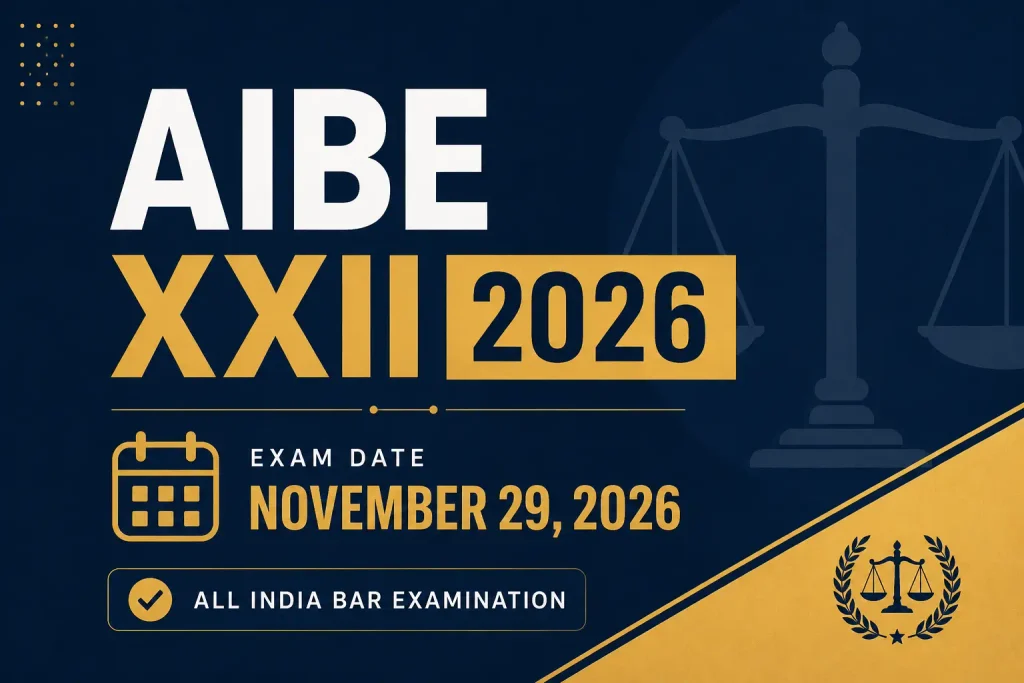
The confirmed AIBE exam 2026 date for the 22nd edition is November 29, 2026
To avoid confusion, this guide focuses strictly on verified information for AIBE 22. Instead of reusing outdated details from previous AIBE cycles, the information provided below comes directly from the Bar Council of India’s official notification published on Jul 18, 2026 and the official AIBE portal.
What Is AIBE XXII ?
It isn’t a competitive exam — the All India Bar Examination has no merit list…
AIBE 22 (AIBE XXII) is scheduled for November 29, 2026.
Registration started on August 19, 2026. I’ve checked the details in this guide with the official notification, but if you’re reading it a few months from now, it’s worth checking the official AIBE website once before relying on any of the dates mentioned here. BCI may issue changes or corrections after the initial notification.
Keep this in mind before we move ahead. This guide is written for three kinds of readers, because the same study advice does not work equally well for everyone. Telling someone to “study for five hours a day for two months” is not very useful without knowing where they are starting from.
For example, a final-year student who has not looked at the Evidence Act since the third semester will have different preparation needs from a candidate appearing again after missing AIBE 21 by just four marks. And their situation is different again from a person working full-time who can only sit down to study after 9 PM.
So, as you go through the guide, I’ll point out which parts are more useful for each type of candidate.
What Is AIBE 22 and What’s Actually Changed From AIBE 21?
If you’re a final-year LLB student, here’s the short version: the All India Bar Examination is a licence exam. Your LLB degree makes you a law graduate. AIBE is what makes you an advocate who’s actually allowed to stand up in court and practise; it’s a qualifying test conducted by the Bar Council of India, and clearing it earns you the Certificate of Practice (CoP), which is the document State Bar Councils use to confirm you’re authorised to appear before courts and tribunals in India.
It isn’t a competitive exam. There’s no merit list, no ranking against other candidates. You either clear the qualifying marks or you don’t, and if you don’t, you can simply register for the next cycle.
Here’s what’s genuinely new about this cycle: earlier in 2026, BCI informed the Supreme Court that AIBE would move to twice a year instead of once. AIBE 22 is a product of that shift—it’s happening barely six months after AIBE 21 (held in June 2026), instead of the year-long gap candidates used to wait through. If you failed AIBE 21 in June, you’re not looking at a 12-month wait anymore. That’s a meaningful change for many people who’d otherwise have to sit on a “fail” for a year while their practice plans stalled.
How this differs from what you might have read about AIBE 21:
If you come across an article mentioning a June 2026 exam, registration dates between February and April 2026, or a once-a-year exam cycle, be careful. That information is about AIBE 21, not AIBE 22.
The subjects in the syllabus may look much the same from one cycle to another. After all, the BCI is not going to change the LLB curriculum every few months. But that does not mean you can carry over dates and other exam-related details from one cycle to the next. Registration deadlines, exam dates, and certain procedures can change, so make sure you are looking at information specifically related to AIBE 22.
Here’s the full All India Bar Examination 2026 schedule, as notified
Here’s the full schedule as notified. Bookmark this section; it’s the one page you’ll come back to most.
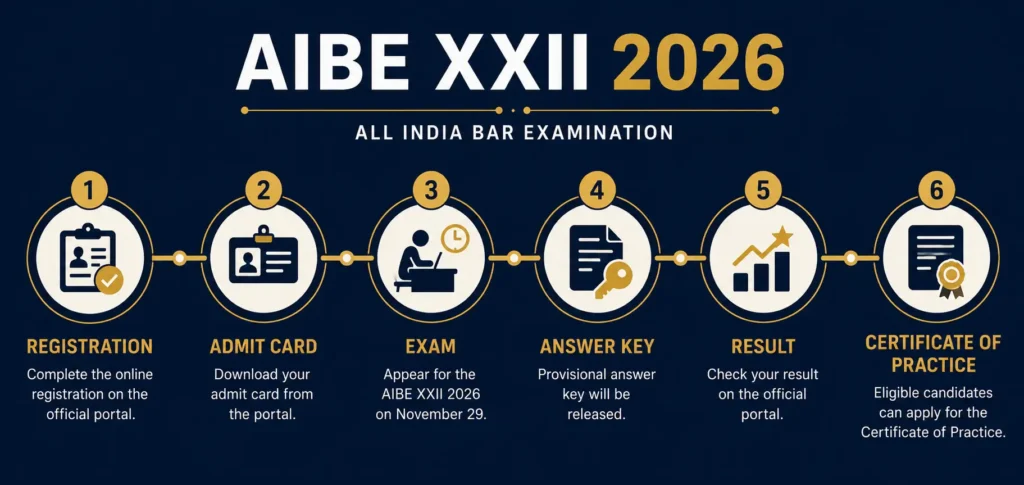
Registration and Fee Deadlines
| Online registration begins | August 19, 2026 |
| Registration closes | October 27, 2026 |
| Last date for fee payment (online) | October 28, 2026 |
| Correction window | October 28–30, 2026 |
Before you submit the application and pay the fee, check these details one more time: your mobile number, email ID, PwD category, caste category, and exam city. Some of these details may not be changeable after payment, even when the correction window is available. So it’s better to get them right before you pay.
Admit Card and Exam Date
| Admit card released | November 14, 2026 |
| AIBE 22 exam date | November 29, 2026 |
Exam timing:
typically 1 PM to 4 PM, with reporting/entry starting earlier (roughly 11:30 AM in recent cycles). Confirm your exact reporting time on the admit card, since it can shift slightly between cycles.
Result Timeline
Tentative result declaration: January 7–10, 2027
That’s roughly a six-week gap between exam and result — plan your job start dates, court joining, or enrolment paperwork with that buffer in mind rather than assuming results land the same week.
AIBE 22 Eligibility Criteria
- You need a 3-year or 5-year LLB from a university or college recognised by BCI.
- If you’re still in your final year or final semester, you can apply too, as long as you don’t have active backlogs from earlier semesters. This is genuinely useful if you’re graduating soon and don’t want to lose six months waiting for your degree to come through formally.
- There’s no minimum percentage requirement in your LLB; BCI hasn’t prescribed one.
- No age limit, upper or lower.
- No cap on the number of attempts. You can sit for AIBE as many times as it takes.
- State Bar Council enrolment isn’t mandatory; just to register for the exam, you can register even before you’ve formally enrolled with your State Bar Council.
If you failed AIBE 20 or AIBE 21, read this part carefully
This is genuinely underexplained everywhere else, and it trips people up every cycle: you don’t need to register again. According to the official AIBE portal notification, if you appeared in and failed AIBE XX or AIBE XXI, you log in using your existing User ID and password, complete the form, and submit it.
If you have already registered for an earlier AIBE attempt, there’s no need to create a new account for AIBE 22. Use the same User ID and password and fill in the application from there. Creating another account can cause problems later if more than one record ends up being linked to your details, especially when you submit your enrolment certificate. And if you’ve forgotten your login details, don’t start a new registration just because you can’t log in. Contact the helpdesk to recover your old login details.
AIBE 22 Exam Pattern
Here’s a quick look at how the AIBE 22 exam is expected to be conducted:
| Mode | Offline, using pen and paper with an OMR sheet. |
| Duration | 3 hours and 30 minutes. PwD candidates with 40% or more disability get an additional 20 minutes for every hour. |
| Total questions | 100 multiple-choice questions. |
| Marking | You get 1 mark for every correct answer, and there’s no negative marking. So even if you’re unsure about an answer, it’s still worth attempting it |
| Passing marks | General and OBC candidates need at least 45 marks, while SC, ST, and PwD candidates need at least 40 marks to pass. |
| Medium | The exam is available in English and more than 20 regional languages, including Hindi, Bengali, Tamil, Telugu, Marathi, Gujarati, Kannada, Malayalam, Punjabi, Urdu, and others. |
The timing looks comfortable at first. You have 3 hours and 30 minutes for 100 questions, so that’s a little over two minutes for each question. But don’t assume you’ll have that much time for every question. Some questions take only a few seconds, while others can take longer, especially when you need to search through a bare act for a particular section. Those small delays can add up before you realise it.
Is AIBE Open Book or Closed Book? (Resolving the Confusion)
This is where different sources genuinely contradict each other, and it’s worth sorting out properly instead of glossing over it.
The accurate picture:
You’re not allowed to bring books, class notes, or any annotated study material into the exam hall, but bare acts without notes are permitted. So it’s not “open book” in the sense of bringing in your own prep material or a commentary. It’s closer to “you can carry the unmarked legislation itself, and nothing else.” If your copy of the Indian Contract Act has your own margin notes, underlining, or sticky tabs with case names on them, that’s likely to be treated as unauthorised material. Check the exact instructions on your admit card, since enforcement details are specified there.
This distinction matters more than it sounds. Bare acts help you locate a section number or verify exact wording; they will not explain a concept to you or tell you which of four MCQ options is correct. Recent AIBE cycles (AIBE XVIII and XIX in particular) have leaned harder into application-based and case-based questions, the kind you can’t answer just by flipping to the right page. Treat AIBE like a reading-comprehension test where you’re allowed a reference shelf, not an exam where the answers are sitting in front of you.
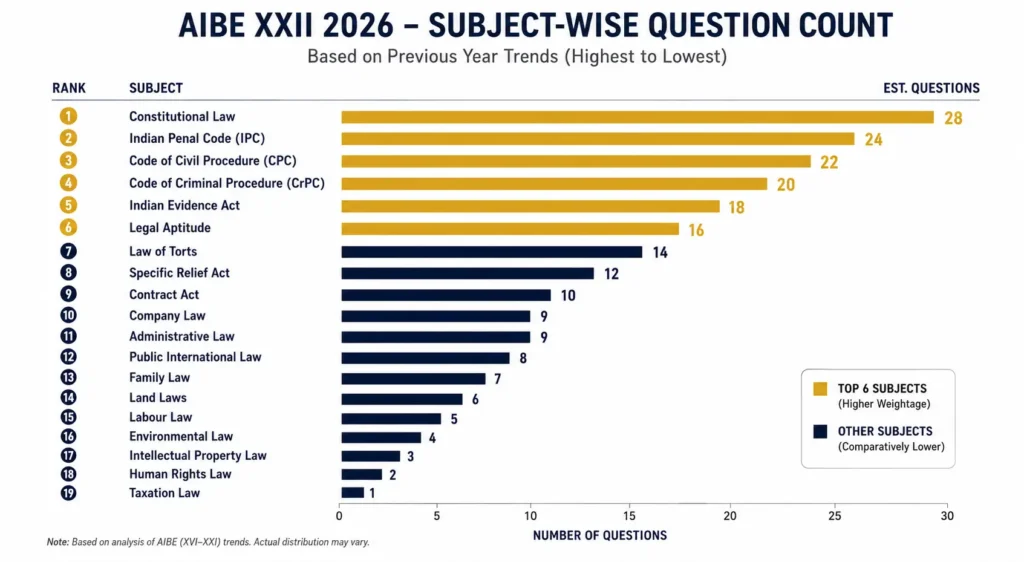
Here’s the complete AIBE exam syllabus 2026 — the full 19-subject breakdown, as per the official notification
| Subject | Questions |
| 1. Constitutional Law | 10 |
| 2. IPC & (New) Bharatiya Nyaya Sanhita | 8 |
| 3. CrPC & (New) Bharatiya Nagarik Suraksha Sanhita | 10 |
| 4. CPC (Code of Civil Procedure) | 10 |
| 5. Evidence Act & (New) Bharatiya Sakshya Adhiniyam | 8 |
| 6. Alternative Dispute Resolution, incl. Arbitration Act | 4 |
| 7. Family Law | 8 |
| 8. Public Interest Litigation | 4 |
| 9. Administrative Law | 3 |
| 10. Professional Ethics & Cases of Professional Misconduct (BCI Rules) | 4 |
| 11. Company Law | 2 |
| 12. Environmental Law | 2 |
| 13. Cyber Law | 2 |
| 14. Labour & Industrial Law | 4 |
| 15. Law of Torts, incl. Motor Vehicles Act & Consumer Protection | 5 |
| 16. Taxation Law | 4 |
| 17. Contract Law, Specific Relief, Property Law, Negotiable Instruments Act | 8 |
| 18. Land Acquisition Act | 2 |
| 19. Intellectual Property Rights | 2 |
| Total | 100 |
Look at that table for a second and notice something most people miss on their first read: the top six subjects Constitutional Law, CrPC, CPC, IPC, Evidence Act, and Family Law/Contract Law account for roughly 52 of your 100 marks. The bottom eight subjects (Company Law, Environmental Law, Cyber Law, Land Acquisition, IPR, and a few others) add up to just 14 marks combined. That gap is the single most important fact in this entire article, and we’ll come back to it in the study plan section.
How Are Old vs New Criminal Law Codes Actually Tested?
You’ve probably noticed three subjects on that table carry both an old name and a new one: IPC alongside Bharatiya Nyaya Sanhita, CrPC alongside Bharatiya Nagarik Suraksha Sanhita, Evidence Act alongside Bharatiya Sakshya Adhiniyam. India’s criminal law framework is mid-transition, and the AIBE syllabus reflects that.
Here’s where honesty matters more than confidence: exactly how questions blend the old and new codes, whether a question tests only the new Sanhita, only the old Act, or asks you to compare the two, isn’t something to guess at from secondary sources. Different guides describe this differently, and getting it wrong could mean you under prepare on exactly the kind of comparative question that’s likely to show up. The safest approach is to check the detailed syllabus PDF on allindiabarexamination.com directly before finalising your revision approach for these three subjects, and to prepare working knowledge of both the old provision and its new equivalent for the core offences and procedures rather than picking one and skipping the other.
That gap in the AIBE exam syllabus 2026 is the single most important fact in this entire article
This is the part almost every AIBE guide skips, and it’s the actual reason people fail despite “knowing the syllabus.” Knowing that Constitutional Law is worth 10 marks is useless if you spend the same three days on it that you spend on Land Acquisition Law, which is worth 2 marks.
Go back to that weightage table. Constitutional Law, CPC, and CrPC alone are 30 of your 100 marks nearly a third of the entire paper and yet they’re exactly the three subjects candidates tend to deprioritise because “I did fine in these during my LLB.” Meanwhile, Land Acquisition, IPR, Cyber Law, Environmental Law, and Company Law combined are only 10 marks, and yet plenty of people burn a full week on each because the subject names feel unfamiliar and intimidating.
Instead of giving every subject the same amount of time, it’s better to start with the subjects that carry more marks. If you have around eight weeks, a practical way to spread your preparation could be:
- Weeks 1–3: Constitutional Law, CPC, and CrPC/BNSS together; these account for about 30 marks.
- Weeks 3–5: IPC/BNS, Evidence Act/BSA, Family Law, and Contract Law — around 24 marks altogether.
- Weeks 5–6: Law of Torts, ADR, Professional Ethics, Labour Law, and Taxation Law — about 21 marks combined.
- Weeks 6–7: PIL, Administrative Law, and the other subjects with lower weightage — around 17 marks.
- Week 8: Use this week mainly for full-length practice papers and revising the topics you struggled with earlier. It’s also a good time to go through Professional Ethics once again, since these questions are often based on understanding the rules and can make a difference when your score is close to the passing mark.
You don’t have to follow these weeks exactly. The main point is to spend more time on the subjects that can give you more marks, while leaving the final week mainly for practice and revision.
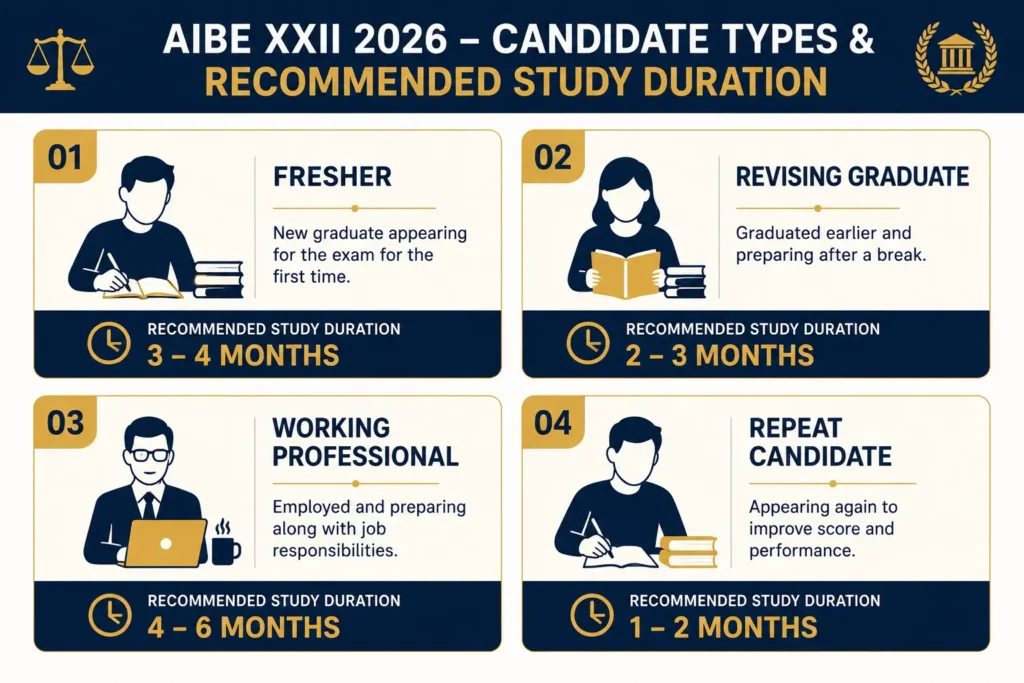
Now, who this actually fits:
If You’re Starting From Zero
If you haven’t started your preparation yet and you’re going through the subjects again for the first time, give yourself the full eight weeks if possible. Even then, eight weeks can feel a little tight when you’re starting from scratch.
One thing you should avoid is trying to read every bare act from the first page to the last. That can take up a lot of time without giving you enough return for the exam. Instead, make short notes for each subject. Keep the important section numbers, basic definitions, and two or three important principles that you are likely to recognise in an MCQ.
AIBE preparation is a little different from preparing for a university exam. You don’t have to study every topic in great detail. What matters more is understanding the important concepts well enough to recognise the correct answer when you come across a question.
If You’re Revising (Recently Finished LLB Course work)
You have an advantage most guides don’t acknowledge: this material is still relatively fresh. Compress the plan above into 5–6 weeks, and spend proportionally more time on practice MCQs than on re-reading material you already know. Your risk isn’t unfamiliarity , it’s overconfidence on subjects you did well in during university but haven’t touched in application-based MCQ form.
If You’re a Working Professional With Limited Study Time
If you’re working in court or spending most of the day at your job, studying for four to six hours every day may not be realistic. Forcing that routine can leave you tired and make it harder to study consistently.
If you’re working and don’t have much time each day, try to get at least 90 minutes of proper study time in. You can still follow the same order of subjects based on their marks, but there’s no need to rush through the whole syllabus in eight weeks. If that feels difficult, take 10 to 12 weeks and work at a pace you can keep up with. Studying a little every day is much better than studying too much for a few days and then losing the routine.
The important thing is not how quickly you finish each subject. Try to cover Constitutional Law, CPC, and CrPC early in your preparation instead of leaving them until the final week when you may be short on time.
If You’re Re-Attempting AIBE (Failed AIBE 20 or 21)
You already have real data: your own paper. Before you touch a fresh study plan, go back through your previous attempt and honestly sort your wrong answers by subject. If most of your misses clustered in one or two subjects, your revised plan should overweight those specifically, even beyond what the general weightage table suggests — a subject worth 4 marks that you consistently get wrong is a worse use of remaining time to ignore than one worth 8 marks you’re already solid on. Twice-yearly AIBE means you likely have less runway between attempts than candidates used to have, so this diagnostic step matters more now, not less.
AIBE 22 Registration: Step-by-Step
- Go to the official site allindiabarexamination.com. Don’t register through any third-party portal.
- Click the AIBE 22 registration link (fresh candidates) or the login link (repeat AIBE 20/21 candidates; see the eligibility section above).
- Use an email ID and mobile number that you currently use and can access. Generate your login credentials for registration.
- Fill in personal, educational, and State Bar enrolment details (enrolment isn’t mandatory, but if you have a number, add it).
- Upload the required documents: LLB degree certificate or final-year marksheet, State Bar enrolment certificate if applicable, a recent passport photo and signature, a government ID (Aadhaar, PAN, Voter ID, or passport), category certificate if relevant, and a disability certificate for PwD candidates.
- Choose your preferred exam city and language medium carefully — remember, exam city is one of the fields that locks after payment.
- Pay the application fee: ₹3,560 (₹3,500 + ₹60 bank charges) for General/OBC, ₹2,560 (₹2,500 + ₹60 bank charges) for SC/ST.
- Review everything, submit, and download/print your confirmation page.
Budget 30–45 minutes for the form if your documents are ready in advance scanned, under 1MB each, and correctly labelled. Most of the time people lose isn’t spent filling fields; it’s spent re-scanning a document that came out too large or blurry the first time.
AIBE 22 Admit Card, Answer Key and Result
Admit card: The admit card should be available from November 14, 2026, on the official AIBE portal. Once it is released, log in with your details and download it. Don’t just save the PDF and forget about it. Check your name, roll number, exam centre and reporting time as soon as you get it. If you notice any mistake, contact the AIBE helpdesk before the exam day.
Answer key and objections:
After the exam, BCI usually releases a provisional answer key for the different question-paper sets. Candidates can normally raise objections during a short period. If you think an answer is incorrect, you can submit an objection through the online portal with the required supporting material and pay the applicable fee. In recent cycles, the objection fee has been around ₹500 per question, and it is refunded when the objection is accepted. BCI then releases the final answer key after considering the objections. The result is prepared using the final answer key.
Result and rechecking:
Once the result is announced, you can check your scorecard through the AIBE portal. If you believe there is an issue with your OMR evaluation, BCI may provide a separate window for rechecking. There is usually a fee for this as well, which may be refunded if the rechecking results in a change in your favour.
Certificate of Practice:
Once you clear AIBE 22, you can move on to the Certificate of Practice (CoP) process. This involves both the BCI and your State Bar Council. Your qualification status may be updated online first, while the physical certificate is issued later. The time taken can be different from one State Bar Council to another, so there is no fixed waiting period. It’s best to keep checking your State Bar Council’s updates for information about document verification and how the certificate will be issued or sent to you.
The Corrected AIBE 22 Guide for Frequently Asked Questions
Not exactly. Bare Acts are allowed, but they must be without notes or annotations. Books, commentaries and personal study material are not allowed. So, it is better to think of AIBE as an exam where you can refer to the Bare Acts, rather than a normal open-book exam.
Yes, subject to the eligibility conditions mentioned in the current AIBE notification. Final-year or final-semester students should also check the latest official instructions before applying.
If you already have an AIBE User ID and password, use those existing login details for AIBE XXII rather than creating another registration.
General and OBC candidates need 45 marks out of 100, while SC, ST and PwD candidates need at least 40 marks.
There is no prescribed limit on the number of attempts. There is also no age limit for appearing in the AIBE, subject to the eligibility requirements applicable to the candidate.
The main difference is the schedule. AIBE 22 is being held much sooner after AIBE 21, as BCI has moved towards conducting the examination twice a year. The overall subject list and exam pattern remain broadly similar, but always check the current notification for exact details rather than relying on information from the previous cycle.
The Last date for registration of AIBE 22 is October 27, 2026
Before You Go
AIBE is not about memorising every line of every law. The real challenge is knowing what to study, giving enough time to the important subjects, and finding the right provision when you need it.
A common mistake is spending too much time on one low-weightage subject while leaving the bigger subjects until the end. Start with the weightage, make a study plan that fits your actual routine, and give yourself enough time to revise.
Also, don’t leave registration or document uploads until the last day. If something goes wrong with your application, you’ll want enough time to sort it out.
If you are using study material alongside your preparation, focus first on the high-weightage subjects and then work through the remaining topics. A simple and consistent study routine is usually more useful than trying to cover everything at once.
Last verified: September 2, 2026. I checked these details with the BCI’s AIBE XXII notification dated July 18, 2026, and the official AIBE portal. Keep in mind that dates or instructions may change, so check the latest update and your admit card before you go for the exam.

ZAKIR HUSSAIN SAHIK
Legal education content creator helping law students find useful study resources and exam information.