TABLE OF CONTENTS

Last verified: September 2026. Exam dates change every cycle — always cross-check the exam’s official website before applying.
If you’ve finished (or are finishing) Class 12 and want to study law, you don’t apply to a law college directly the way you would for a regular BA or BCom. Almost every good law school in India — from the National Law Universities to state government colleges — admits students through a dedicated entrance exam. This guide walks through which exams exist, who they’re for, and how to decide where to focus your effort.
Quick Answer — Which Exam Should You Take?
- Aiming for a National Law University (NLU) anywhere in India? Take CLAT.
- Set your heart on NLU Delhi specifically? You’ll need AILET — NLU Delhi does not accept CLAT scores.
- Considering private law schools alongside NLUs? Add LSAT India to your list; many private colleges accept it.
- Live in (or want to study in) a specific state like Telangana, Andhra Pradesh, or Maharashtra? Your state CET (TG LAWCET, AP LAWCET, MH CET Law, etc.) usually offers far more seats at a fraction of the competition.
Most serious aspirants don’t pick just one — they take CLAT plus their home-state CET as a backup, since the exams share most of the same core skills (English, reasoning, general knowledge, and basic legal aptitude).
The Two Ways Into a Law Career After 12th
- The 5-year integrated route (right after Class 12): Courses like BA LLB, BBA LLB, BCom LLB, or BSc LLB combine an undergraduate degree with a law degree in one five-year program. This is the path this guide focuses on.
- The 3-year LLB route (after graduation): You first complete any bachelor’s degree, then apply separately for a 3-year LLB — typically through university-specific tests like DU LLB or CCS University’s law entrance exam. If you’re already a graduate exploring this route, a syllabus-focused guide (like a 3-year LLB semester breakdown) is more useful than this one.
National-Level Law Entrance Exams
CLAT (Common Law Admission Test)
CLAT is the largest and most widely accepted national law entrance exam, conducted by the Consortium of National Law Universities for admission to 27 NLUs.
- Mode: Offline (pen-and-paper)
- Duration: 2 hours
- Pattern: 120 MCQs across English Language, Current Affairs & GK, Legal Reasoning, Logical Reasoning, and Quantitative Techniques
- Scoring: +1 point per correct response, −0.25 penalty per incorrect response
- Eligibility: Passed (or appearing for) Class 12 with at least 45% marks (40% for SC/ST candidates); no upper age limit
- 2027 cycle: Notification released July 22, 2026; registration opened August 3, 2026 and closes October 31, 2026; the exam is scheduled for December 6, 2026.
An Expert Committee (chaired by Justice Indu Malhotra) has reviewed CLAT’s format, but any changes are expected from the 2028 cycle onward — the 2027 pattern stays the same as previous years.
AILET (All India Law Entrance Test)
AILET is NLU Delhi’s own entrance exam. It’s a separate track from CLAT — an AILET score only works for NLU Delhi, and NLU Delhi doesn’t accept CLAT scores.
- Mode: Offline (pen-and-paper)
- Duration: 120 minutes
- Pattern: Objective questions in English, General Knowledge & Current Affairs, and Legal/Logical Reasoning
- Marking: +1 for correct, −0.25 for incorrect
- Eligibility: Similar to CLAT — Class 12 pass with minimum qualifying marks; no age limit
- 2027 cycle: Registration began August 7, 2026; the exam is scheduled for December 13, 2026, a week after CLAT, so students commonly prepare for both together.
LSAT India
LSAT India is accepted by a large number of private law schools rather than government NLUs.
- Duration: 2 hours 20 minutes
- Pattern: Analytical Reasoning, Logical Reasoning (two sections), and Reading Comprehension — no general knowledge or current affairs section, which makes it distinct from CLAT/AILET
- Marking: Scaled score (roughly 420–480 range), not raw marks
- Eligibility: Set independently by each participating law school, so check your target college’s specific criteria
State-Level Law Entrance Exams (CETs)
If you’re set on studying in a particular state, or want a realistic backup to the highly competitive national exams, state CETs deserve just as much attention. Seat numbers here run into the thousands, and competition is usually less intense than for the top NLUs.
TG LAWCET / TS LAWCET (Telangana)
TG LAWCET serves as the primary entrance examination for admission into 3-year and 5-year LLB courses in Telangana law colleges. Administered by Osmania University under the direction of the Telangana State Council of Higher Education (TGCHE), the exam follows a computer-based test (CBT) format with no penalty for wrong answers. Official updates, hall tickets, answer keys, and counselling procedures are available on lawcet.tgche.ac.in. Candidate participation has grown significantly, with registration exceeding 61,000 for the 2026 session—an increase of approximately 8,000 from the prior year. The admission process involves online registration, document uploads, fee payment, examination appearance, key verification, and subsequent counselling rounds.
- Mode: Computer-based test (CBT)
- Marking: No negative marking
- Official portal: lawcet.tgche.ac.in — this is the only official site for registration, hall tickets, answer keys, results, and counselling; avoid third-party sites for the actual application
- Recent scale: Over 61,000 candidates registered for the 2026 cycle, roughly 8,000 more than the year before
- Process: Register online with personal and academic details → upload photograph and signature → pay the fee → download hall ticket closer to the exam → appear for the CBT → check the provisional and then final answer key → result and counselling follow
AP LAWCET (Andhra Pradesh)
Administered by Acharya Nagarjuna University on behalf of the Andhra Pradesh State Council of Higher Education (APSCHE), for both 3-year and 5-year LLB programs at AP universities and affiliated colleges.
- Mode: Computer-based test, offered in both Telugu and English
- Duration: 90 minutes
- Note: A score of roughly 90+ out of 120 is generally considered strong for admission to well-regarded colleges, though this shifts each year with the difficulty level and competition.
MH CET Law (Maharashtra)
Conducted by the State Common Entrance Test Cell, Maharashtra, for both the 5-year and 3-year LLB programs at participating Maharashtra colleges.
- Mode: Online, computer-based
- Duration: 2 hours
- Pattern (5-year LLB): Legal Aptitude & Logical Reasoning, GK & Current Affairs, Logical/Analytical Reasoning, English, Mathematics
- Marking: +4 per correct answer, no negative marking
- Eligibility: Passed 12th with the minimum required marks; candidates from Maharashtra’s reserved categories have a slightly relaxed age limit compared to the general category
Other University and State-Specific Tests
Several universities run their own admission tests rather than relying on a state CET or CLAT — for example, Delhi University’s law entrance process, Banaras Hindu University’s UET, Jamia Millia Islamia’s BA LLB test, and CUET-based LLB admissions at some central universities. If a specific university or college is your target, check that institution’s official admissions page directly rather than relying on a generic list, since these change independently of CLAT or the state CETs.
Let’s Know About Law Entrance Exams After 12th in India: Complete Guide (2027 Admissions)
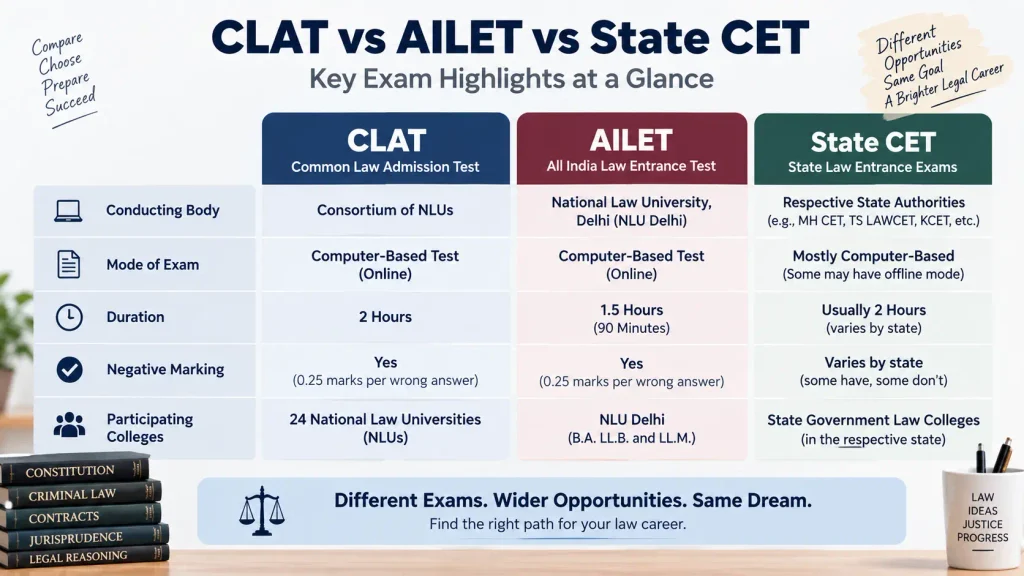
National vs. State Exams — Comparison Table
| Exam | Conducted By | Mode | Duration | Negative Marking | Best For |
| CLAT | Consortium of NLUs | Offline | 2 hours | Yes (−0.25) | Any of the 27 NLUs nationwide |
| AILET | NLU Delhi | Offline | 120 min | Yes (−0.25) | NLU Delhi only |
| LSAT India | LSAC | Online/Offline (varies) | 2 hr 20 min | No | Private law schools |
| TG LAWCET | Osmania University / TGCHE | Online (CBT) | 90 min | No | Law colleges in Telangana |
| AP LAWCET | Acharya Nagarjuna University / APSCHE | Online (CBT) | 90 min | No | Law colleges in Andhra Pradesh |
| MH CET Law | State CET Cell, Maharashtra | Online (CBT) | 2 hours | No | Law colleges in Maharashtra |
Eligibility Criteria at a Glance
Across almost every exam on this list, the baseline requirements are similar:
- Passed (or appearing for) Class 12 / equivalent from a recognized board
- Minimum aggregate marks generally between 40–45%, with relaxations for SC/ST/reserved categories depending on the exam
- No upper age limit for CLAT, AILET, or most state CETs (always confirm on the official notification, as rules can differ by state and by year)
How to Choose the Right Exam for You
Rather than treating this as a single decision, think of it in layers:
- Start with CLAT if a national reputation and mobility across states matters to you — it opens the door to 27 NLUs at once.
- Add AILET only if NLU Delhi specifically is on your list — it’s a separate exam with a separate application.
- Add your home-state CET as a realistic, high-seat-count option — it’s usually less competitive and guarantees you a strong fallback even if the national exams don’t go your way.
- Consider LSAT India if private law schools with a good placement record are on your shortlist and you don’t want to rely purely on GK-heavy exams.
Applying to more than one exam is common and sensible — the core skills (comprehension, reasoning, and current affairs) overlap heavily, so preparing for one strengthens the others.

A Month-Wise Preparation Plan
- 6–8 months out: Build reading habits — a daily newspaper, one current-affairs digest a week, and basic legal-aptitude concepts (landmark cases, legal maxims, the structure of the Constitution).
- 4–6 months out: Start section-wise practice — English comprehension, logical/analytical reasoning, and legal reasoning passages. Take a diagnostic mock test to identify weak areas.
- 2–3 months out: Shift to full-length timed mocks weekly. Review every mistake, not just the score — understanding why an answer was wrong matters more than the number.
- Final month: Focus on revision and speed — go through condensed notes, attempt previous years’ papers under exam conditions, and stop learning new topics in the last week.
Common Mistakes 12th-Grade Aspirants Make
- Preparing for only one exam and treating a national exam as the only option, which leaves no backup if that single attempt doesn’t go well.
- Ignoring current affairs until the last month — this section rewards consistent daily reading over cramming.
- Skipping the official notification and relying only on third-party blogs for dates, fee amounts, or eligibility — always verify on the exam’s official website before applying.
- Underestimating state CETs — some students only target CLAT/AILET and miss a state CET deadline that could have secured them a solid seat.
What Comes After — Career Paths With a Law Degree
A law degree opens into several distinct careers, not just courtroom litigation:
- Litigation lawyer — representing clients in court, drafting pleadings, and advocacy
- Corporate lawyer / legal advisor — handling compliance, contracts, and mergers for companies
- Judiciary — after further preparation for judicial services exams
- Legal researcher or academic — working with law firms, think tanks, or teaching
- Human rights or public-interest law — working with NGOs or international organizations
- Higher studies (LLM) — specializing further in areas like Constitutional law, Criminal Law, Corporate Law, IPR, or Cyber Law after the base degree
People Also Ask
Is CLAT compulsory for a law course after 12th?
No. CLAT covers National Law Universities specifically. You can also get into a good law college through AILET (NLU Delhi), LSAT India (private colleges), or a state CET (state government and affiliated colleges) without ever taking CLAT.
Can I take both CLAT and a state CET?
Yes, and it’s a common strategy. The exams don’t clash in registration, and preparing for one builds skills useful for the other.
Is there negative marking in every law entrance exam?
No. CLAT, AILET, and DU-style exams typically have negative marking, while most state CETs (TG LAWCET, AP LAWCET, MH CET Law) do not.
What is the minimum percentage required in 12th for law entrance exams?
Most exams require 40–45% aggregate in Class 12, with a relaxation of a few percentage points for SC/ST and other reserved categories — but this varies by exam, so check the specific notification.
FAQs
CLAT 2027 is scheduled for December 6, 2026, and AILET 2027 for December 13, 2026. State CETs like TG LAWCET typically hold their exams around May each year — check the official portal closer to the date, as schedules can shift.
Not strictly — many students clear these exams through self-study using standard reference books and mock tests. Coaching can help with structure and discipline, but it isn’t a guarantee, and it isn’t a requirement listed by any exam’s eligibility criteria.
State CETs are generally considered less competitive than CLAT because they draw from a state-specific pool and don’t have negative marking in most cases, but “easier” also depends on your own strengths — some students find GK-heavy state papers harder than CLAT’s reasoning-focused format.
Yes. Nearly all law entrance exams after 12th are open to students from all academic streams — whether Arts, Commerce, or Science.— as long as the minimum aggregate marks are met.
Conclusion
There’s no single “best” law entrance exam after 12th — the right one depends on whether you’re chasing a national law school, a specific university like NLU Delhi, a private college, or a strong option in your home state. The most reliable strategy for most aspirants is to prepare for CLAT as the core exam, since its syllabus overlaps with almost everything else, and then layer on AILET, LSAT India, or a state CET based on where you’d actually be happy studying. Start early, verify every date on the exam’s official website, and treat your state CET as a genuine option rather than a fallback.

ZAKIR HUSSAIN SAHIK
Legal education content creator helping law students find useful study resources and exam information.