
Let’s learn how e-PDF Study Materials Can Support LLB Exam Preparation
Law syllabi can be quite dense, but we’re here to help you navigate and understand them better! Exam patterns change, and no LLB student can carry six semesters’ worth of textbooks in a bag. That’s why e-PDF study material — digital notes, bare acts, case-law compilations, and previous-year papers in PDF form—has become a default part of how law students study. But downloading a folder full of PDFs doesn’t automatically translate into better exam performance. What matters is how you choose, organise, and use those files.
This guide covers both sides: why e-PDFs genuinely help, and how to use them so they actually improve your preparation instead of just cluttering your drive.
Table of contents
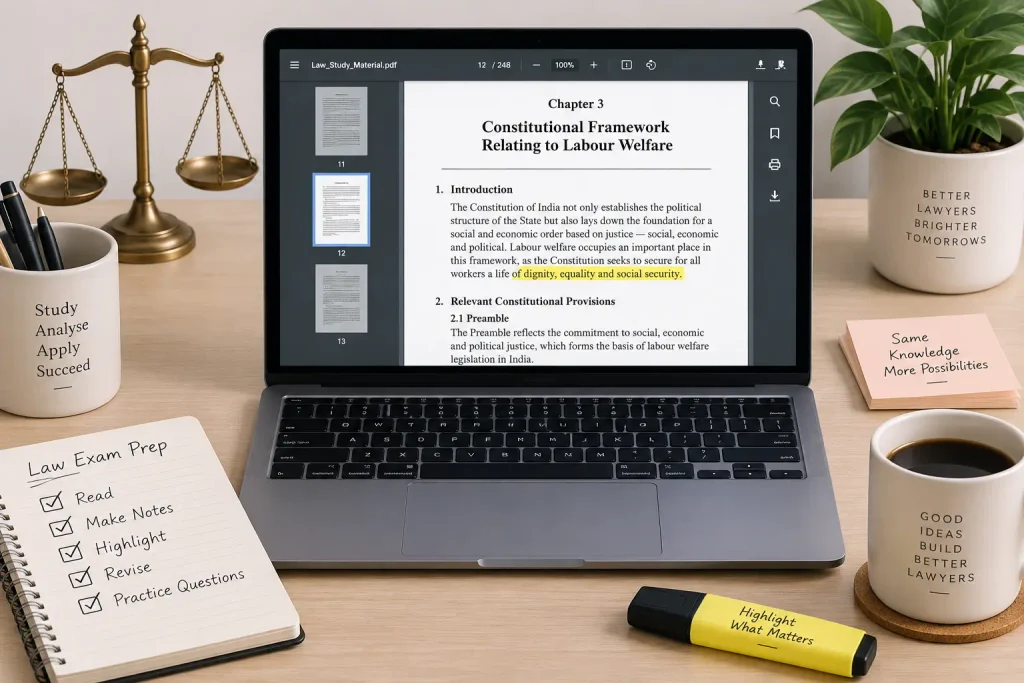
What Counts as “e-PDF Study Material”
For LLB students, e-PDF material typically falls into a few categories:
- Subject notes and outlines — condensed coverage of a paper (Contract Law, Constitutional Law, Jurisprudence, and so on)
- Bare acts and statutes — the actual text of laws, often the most important reference of all
- Case law compilations — summarized judgments organized by topic or subject
- Previous-year question papers (PYQs) and model answers
- Reference book excerpts shared by faculty or seniors
Each type serves a different purpose in your prep, and treating them all the same is one of the more common mistakes students make (more on that below).
Why LLB Students Are Leaning on e-PDFs
They’re searchable. Finding a specific section, case name, or definition in a 600-page printed text can take minutes. In a PDF, it takes seconds with Ctrl+F. For a subject like Constitutional Law, where you’re constantly cross-referencing Articles, this alone saves significant revision time.
They’re portable. A semester’s worth of notes, bare acts, and case digests can sit on one phone or laptop, which matters during exam weeks when you’re moving between library, hostel, and coaching sessions.
They’re easier to keep current. Legal provisions, amendments, and landmark judgments change. A PDF can be replaced or updated far more easily than a printed edition, provided you’re pulling from a source that actually updates it.
They support active study, not just reading. Digital notes can be highlighted, annotated, and searched — turning a passive read-through into something closer to active revision, if you use the tools properly.
They pair naturally with mock tests and PYQs. Most entrance and semester exam practice today happens through PDF question banks anyway, so keeping your notes in the same format makes cross-referencing simpler.
None of this replaces understanding the law. It just removes friction from the process of reviewing it.
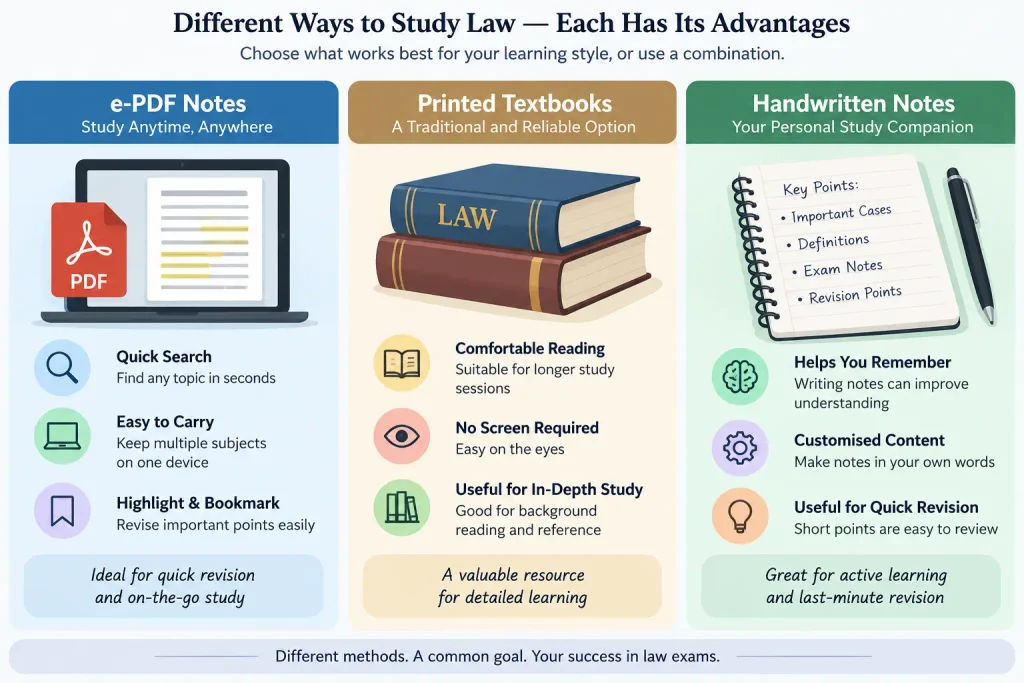
PDF vs Printed Textbook vs Handwritten Notes
| Factor | e-PDF Material | Printed Textbook | Handwritten Notes |
|---|---|---|---|
| Searchability | High — instant keyword search | Low — manual index/page flipping | None |
| Portability | Very high (one device, many files) | Low — heavy, single-subject | Depends on volume |
| Cost | Usually free or low-cost | Higher, especially for reference sets | Free (just your time) |
| Retention while reading | Moderate — depends on annotation habits | High if actively marked up | Highest — writing aids recall |
| Ease of updating | High — replace the file | Low — new edition needed | Manual rewriting |
| Distraction risk | Higher (same device as everything else) | Low | Low |
The practical takeaway: e-PDFs are best used for reference, search, and revision layering — not as a total replacement for the retention benefits of writing things out yourself, especially for concepts you’re still learning for the first time.
How to Actually Use e-PDF Material Effectively
1. Organize by subject and semester, not by download date
A folder named “Downloads” with 40 randomly named PDFs is not a study system. Create a folder per subject, and within it, separate bare acts, case compilations, and notes. This alone saves hours during pre-exam panic when you’re trying to locate the right file.
2. Annotate instead of just reading
Passive reading of a PDF is barely more effective than passive reading of a textbook. Use highlighting, comments, or a simple color code (for example: yellow for definitions, green for case names, pink for exam-relevant exceptions) so a second pass through the document is faster and more targeted.
3. Cross-check against the bare act or original source
Compiled notes summarize the law, but they can lag behind amendments or contain errors introduced during compilation. Whenever a PDF’s summary of a provision seems important enough to quote in an exam, verify it against the actual bare act or an official judgment text.
4. Build a revision layer — a shorter summary sheet
Don’t revise from the full PDF every time. After your first close read, extract key points into a shorter summary document (even a two-page PDF of your own) per subject. This becomes your primary revision tool in the final weeks, while the original PDF stays as a reference for anything you need to look up in detail.
5. Pair PDFs with mock tests and PYQs
Reading notes tells you what you know; solving previous-year papers tells you how well you can apply it under time pressure. Treat PDF-based PYQs as practice tests, not just reading material — attempt them with a timer before checking the model answers.
6. Use PDF search to build a personal case-law index
As you go through case-law PDFs, keep a running index (even a simple spreadsheet) of case name, subject, principle, and page/PDF reference. Searching across dozens of PDFs for “which case established this principle” is far slower than searching one index file.
Common Mistakes Students Make With PDF Notes
- Hoarding files without reading them. Having “complete” material for every subject feels productive but isn’t preparation on its own.
- Trusting unverified compilations. Not every PDF circulating on file-sharing sites is accurate or current — some are outdated, incomplete, or contain transcription errors.
- Studying only from summaries. Condensed notes are useful for revision but can strip out reasoning and nuance that essay-style law exams actually reward.
- No backup or version control. Losing a semester’s organized notes to a corrupted file or lost device is common and avoidable with basic cloud backup.
- Treating every PDF as equally reliable. A note set shared by a senior who scored well is not the same tier of source as an official bare act or a verified case digest — both are useful, but for different purposes.
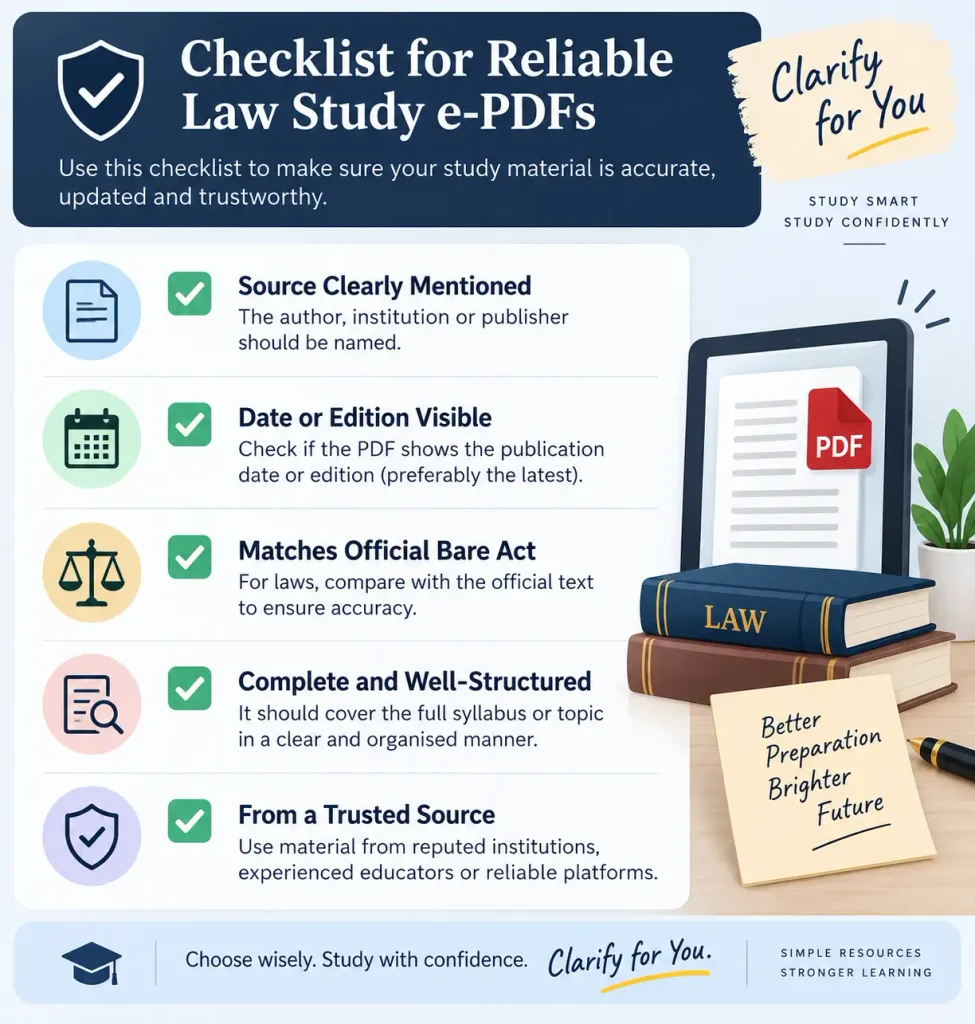
Choosing Reliable e-PDF Sources
| Source Type | Reliability | Best Used For |
|---|---|---|
| Official government/legislative portals | High | Bare acts, amendments, gazette notifications |
| University or faculty-shared material | High | Syllabus-aligned notes, past papers |
| Established legal publishers/exam-prep platforms | Moderate–High | Structured subject notes, entrance exam material |
| Senior-shared or peer-compiled notes | Variable | Quick revision, exam-pattern insight — verify facts separately |
| Random file-sharing uploads | Low–Variable | Use only as a starting point; always cross-check |
If a PDF doesn’t mention a source, edition, or date, treat any specific legal claim in it with caution rather than exam-ready certainty — especially for provisions that have seen recent amendments.
Where e-PDFs Fit Into Entrance Exam Prep
Aspirants preparing for law entrance exams (such as CLAT and other university-level LLB entrance tests) rely heavily on PDF-based question banks, current-affairs compilations, and legal-reasoning practice sets, since these formats update faster than printed guides. The same rules apply here as for semester prep: verify the source, don’t rely solely on summarized “static GK” PDFs for legal reasoning questions, and prioritize timed practice from PDFs over passive reading. Entrance exam patterns and syllabi can change year to year, so always check the official notification from the conducting body before finalizing your prep material.
FAQs on How e-PDF Study Materials Can Support LLB Exam Preparation
Not by themselves. They’re most effective as a searchable, organized layer on top of your classes, textbooks, and case-law reading — not a full substitute for understanding the reasoning behind a judgment or provision.
Check for a source, publisher, or date. Cross-reference any specific legal provision against the current bare act, and treat undated or unattributed compilations as a starting point rather than a final answer.
It’s better to use both. Textbooks and classroom reading build the foundational understanding of legal reasoning, while PDFs are excellent for revision, quick reference, and building a searchable case-law index once that foundation is in place.
Not by themselves. They’re most effective as a searchable, organized layer on top of your classes, textbooks, and case-law reading — not a full substitute for understanding the reasoning behind a judgment or provision.
Conclusion
e-PDF study material doesn’t replace the actual work of understanding law — but used well, it removes a lot of the friction around finding, organizing, and revising what you’ve learned. The students who benefit most from PDFs aren’t the ones with the biggest folder of downloads; they’re the ones who organize by subject, verify what they rely on, and pair their reading with active revision and timed practice.

ZAKIR HUSSAIN SAHIK
Legal education content creator helping law students find useful study resources and exam information.